7 Best Rork Alternatives in 2026 (For Mobile, Web and Full-Stack Apps)
This comparison draws on publicly available product information and pricing.
Rork is one of the most popular vibe coding tools for mobile apps.
Like other chat-based AI app builders, it turns a plain-English description into an app. Rork builds native iPhone apps in Swift and Android apps in Kotlin, then helps you publish them to the App Store and Google Play.
But it is not the right fit for every team.
Some builders run through credits faster than expected. Others want one React Native codebase, or they need a web app and a backend that work alongside the mobile app.
If that sounds familiar, the right Rork alternative depends on what you are building, not on which tool has the longest feature list.
This guide compares apps like Rork on four things: what they build, how they handle the backend, how far they go with app store publishing, and what they cost.
Here are the 7 Rork alternatives that stood out.

Create React Native mobile apps and React web apps with one shared backend and database, all from simple AI prompts.
Start building with Vitara.ai →
TL;DR: Our Top 3 Rork Alternatives
If you are short on time, here are the top 3 picks.
Vitara.ai (Best Overall for Full-Stack Business Apps)
Vitara.ai builds React Native + Expo mobile apps and React web apps on one shared backend and database. It’s also a free Rork alternative to start with: the Starter plan includes 10 credits, and paid plans start at $20/month.
Start Building with Vitara.ai →
Vibecode (Best for Native Swift iPhone Apps)
Vibecode writes native SwiftUI apps and compiles them on cloud Macs. The first app build is free for new accounts, and paid plans cost $20 a month for Plus, $50 for Pro and $200 for Max.
FlutterFlow (Best for Visual Control and Code Export)
FlutterFlow builds one Flutter codebase for iOS, Android and web in a visual editor with AI help. Basic is $39 a month, or $29 a month billed yearly.
A Quick Comparison of 7 Rork Alternatives at a Glance
Here is how the top Rork competitors compare on what they build, starting price and store publishing.
| Tool | What It Builds | Starting Price | Best For | Store Publishing |
|---|---|---|---|---|
| 1. Vitara.ai | React Native + Expo mobile, React web, Python/Node.js backend, MongoDB | Free; $20/mo | Full-stack business apps on web and mobile | Test via Expo Go; download code to publish [CONFIRM] |
| 2. Vibecode | Native Swift iPhone/iPad, React Native, web | Free first build; $20/mo | Native Swift iPhone apps | Submits to App Store review; no built-in Google Play step |
| 3. FlutterFlow | Flutter apps for iOS, Android and web | Free; $39/mo | Visual control and code export | Deploys to both stores on paid plans |
| 4. CatDoes | Expo mobile apps and websites | Free; $20/mo | An app and a website in one project | App Store submission; Android file you upload |
| 5. Rocket.new | Next.js web, Flutter mobile | Free; $25/mo | Web and Flutter mobile from one prompt | One-click web deploy; check mobile store steps |
| 6. Bolt.new | Full-stack JavaScript web, Expo mobile | Free; $25/mo | Web apps first | No built-in store step (uses Expo tools) |
| 7. Superapp | Native Swift for iPhone, iPad, Watch and Mac | Free credits; $25/mo | Apple-only apps | Prepares App Store submission; no Android |
Prices are monthly list prices from each vendor’s pricing page, checked in November 2026. Check the official pages for the latest pricing.
Why Are Users Looking for Rork Alternatives?
Rork does a lot well. It focuses on mobile apps, compiles iOS apps in the cloud, and has real success stories. For example, an 18-year-old college freshman built WrestleAI, an AI-powered wrestling coach, with Rork in roughly a month and scaled it to over $30,000 in monthly revenue.
But teams that move away from Rork tend to mention the same four problems.
- Credits run out during fixes. Rork’s paid plans range from $20 to $1,800 per month, and in India plans start at ₹649 (about $8) per month. Credits reset on the 1st of each month. A founder who spends six prompts fixing one login bug uses credits meant for new features, and Rork pricing gets harder to predict.
- New projects are no longer React Native. Rork now builds native iOS apps in Swift, Android apps in Kotlin, and web apps. React Native, a framework that runs one codebase on both iPhone and Android, is no longer the default for new projects. Teams that want one shared codebase now look for a React Native app builder elsewhere. Rork Max users face a second limit: Rork Max apps are iOS-only and cannot be published to Google Play, which is why some search for a Rork Max alternative.
- Many businesses need a web app too. A clinic might need a patient app on phones and a staff dashboard in the browser, both reading the same appointment data. Rork builds web apps, but its iPhone, Android and web apps use three different languages. For business apps, many founders prefer one stack where the frontend and backend are built together.
- App review is a real hurdle. Apple reviewed 9,100,620 app submissions in 2025 and rejected 2,093,244, about 23%. Performance issues caused the most rejections, at 1,354,418. On Android, personal developer accounts created after November 13, 2023 must run a closed test with at least 12 testers opted in continuously for 14 days. No AI mobile app builder removes these steps, so testing generated code before launch matters more than build speed.
These are not criticisms of Rork. It is a matter of fit.
If your app needs more than a native mobile build, it is worth comparing your options.
Our List of 7 Best Rork Alternatives and Competitors
Each tool below was compared using its official pricing page and documentation in November 2026. No tool paid to be included, and we did not run speed benchmarks.
We focused on vibe coding tools that build complete apps from a prompt. AI code editors such as Cursor and Windsurf are left out because shipping an app with them requires coding skills.
1. Vitara.ai
Builds: React Native + Expo mobile apps, React web apps, Python or Node.js backend, MongoDB database
Publishes to: Web (one-click, from $5/month); mobile apps tested on your phone with Expo Go [CONFIRM store publishing]
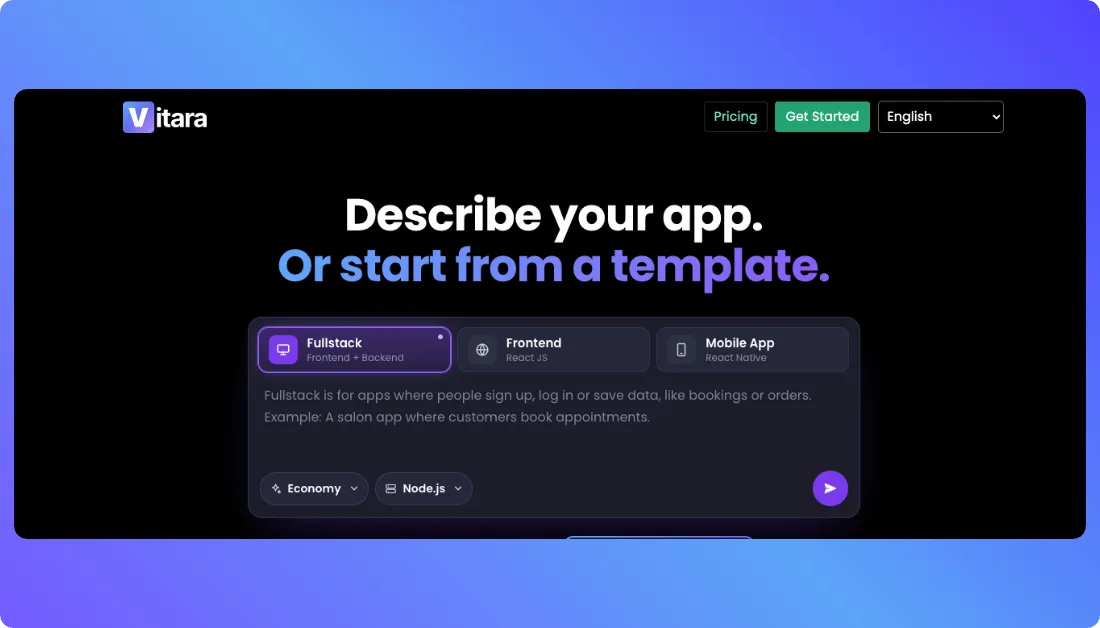
Vitara.ai is the best overall Rork alternative for business apps, for 4 reasons.
- It builds a mobile app and a web app on one shared backend, so both show the same data.
- It keeps React Native + Expo, so one codebase runs on iPhone and Android.
- It offers templates with screens, backend, database and login already built.
- It lets you download your code and deploy anywhere.
Vitara works through chat. Each message updates the screens, API and database together, so the app stays in sync as it grows.
Templates speed up common builds. A dental clinic can start from Appointment Booking, a hotel or homestay from Hotel & Home Stay, and an event organizer from Event Ticketing. You can also explore industry-specific builders.
Real users include Nilesh Mevada, a real estate builder who created a construction management system. Another is Dr. Gaurav Patel, a gastro surgeon with no technical background who built a patient survey system, a practical example of AI tools in healthcare.
The trade-off is planning. Vitara builds your own app rather than a ready-made portal, so it needs more thought up front. Generated login, payments, permissions and integrations should be tested before launch.
How Vitara.ai Compares to Rork
On stack, Rork writes new projects as separate Swift and Kotlin apps. Vitara keeps one React Native codebase for both phones, plus a React web app.
On backend, Rork offers Rork Backend for realtime data, auth and storage. Vitara’s web and mobile apps share one backend and database with no third-party service to connect.
On pricing, Rork Pro starts from $20/month, the same as Vitara’s Build plan. Vitara’s Economy Mode lowers the credits used per edit.
Where Rork wins: if you need a fully native Swift or Kotlin app, Rork is the stronger choice. It also offers an AI App Store Reviewer to catch App Store rejections early.
Key Features of Vitara.ai
- Three build types: Fullstack, Frontend (React JS) or Mobile App (React Native + Expo)
- Shared backend: web and mobile apps use the same API and MongoDB database
- Templates: CRM, HRMS, Job Portal, Billing with GST/e-invoicing and more
- Economy Mode: a smaller model that uses fewer credits for everyday edits
- Phone testing: scan a QR code with the free Expo Go app
- Code ownership: download your code and data anytime
Vitara.ai Pricing
Vitara.ai offers three plans:
- Starter: Free, 10 credits total, free templates, Economy Agent
- Build: $20/month, 100 credits/month, no daily limit, Visual Edits, code download, custom domain
- Scale: $50/month, 250 credits/month, all templates including Premium, team collaboration
Publishing starts at $5/month. A booking app MVP takes about 60 credits from scratch, about 40 from a template, and about 20 with a template plus Economy Mode. That is a saving of up to about 66% (approximate). See the Vitara.ai pricing page for current details.
For head-to-head comparisons,
see Vitara vs Lovable, Bolt.new vs Vitara, Base44 vs Vitara and Emergent vs Vitara.
Build both from one chat, test the mobile app on your phone, and keep full ownership of your code.
Start building with Vitara.ai →
2. Vibecode
Builds: Native Swift iPhone and iPad apps, React Native + Expo mobile apps, web apps
Publishes to: App Store (native Swift apps are submitted for you)
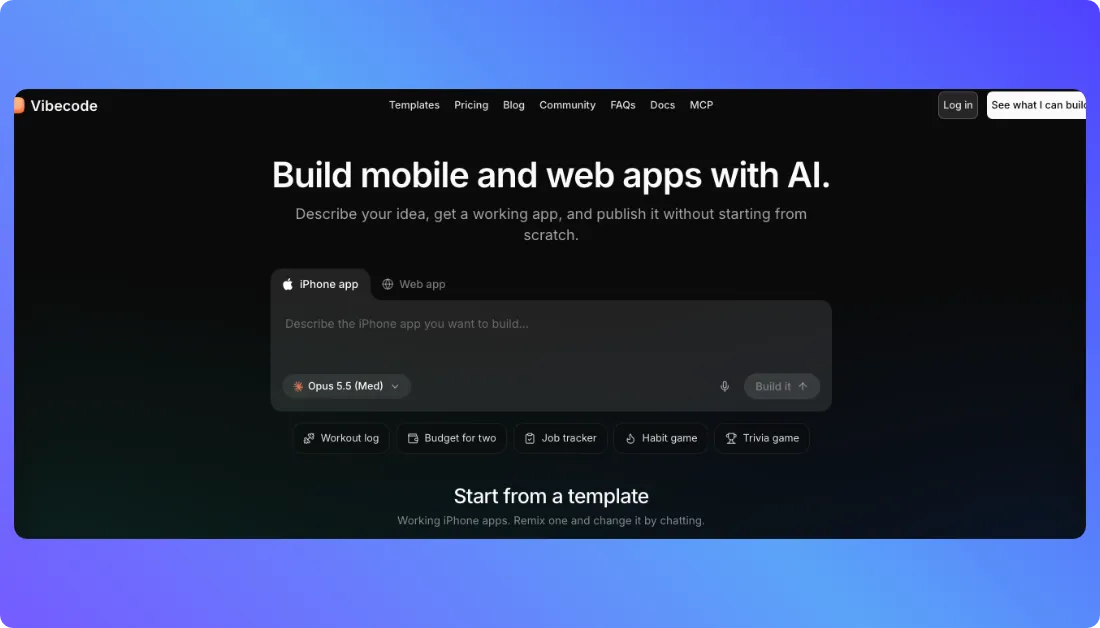
Vibecode is the best Rork alternative for native iPhone apps, for 3 reasons.
- It writes SwiftUI apps for iPhone and iPad as standard Xcode projects that you own.
- You don’t need a Mac or Xcode, because Vibecode compiles your app on cloud Macs and streams a cloud iOS Simulator to you.
- For native Swift apps, Vibecode builds, signs, uploads and submits the app for review.
Vibecode suits founders whose product lives on the iPhone, such as a habit tracker or a fitness coaching app. Its scale is real: it is used by hundreds of thousands of people.
The trade-off is the backend. Vibecode does not build a shared web and mobile backend for business workflows, so team dashboards need extra work.
How Vibecode Compares to Rork
On platforms, both build native Swift iPhone apps. Rork also writes native Kotlin for Android, while Vibecode’s Android path is React Native, which runs on iOS and Android.
On pricing, unused Vibecode credits roll over while your plan is active. That helps builders who work in bursts.
Where Rork wins: native Kotlin Android apps and a single native workflow for both stores.
Key Features of Vibecode
- Native SwiftUI: real Xcode projects for iPhone and iPad
- Cloud Macs: build and preview without owning a Mac
- App Store submission: handled for native iOS apps
- Three app types: iOS, React Native mobile and web
- Premium models: building with Claude, GPT and Gemini, with no API keys of your own
Vibecode Pricing
- Free: $2.50 in credits in total
- Plus: $20/month, $20 in credits, App Store submission
- Pro: $55 in credits per month, plus source code download and SSH to Cursor, so developers can keep working in their preferred AI coding tools
- Max: $200/month with $220 in credits
3. FlutterFlow
Builds: Flutter apps for iOS, Android and web
Publishes to: App Store and Google Play (Basic plan and up)
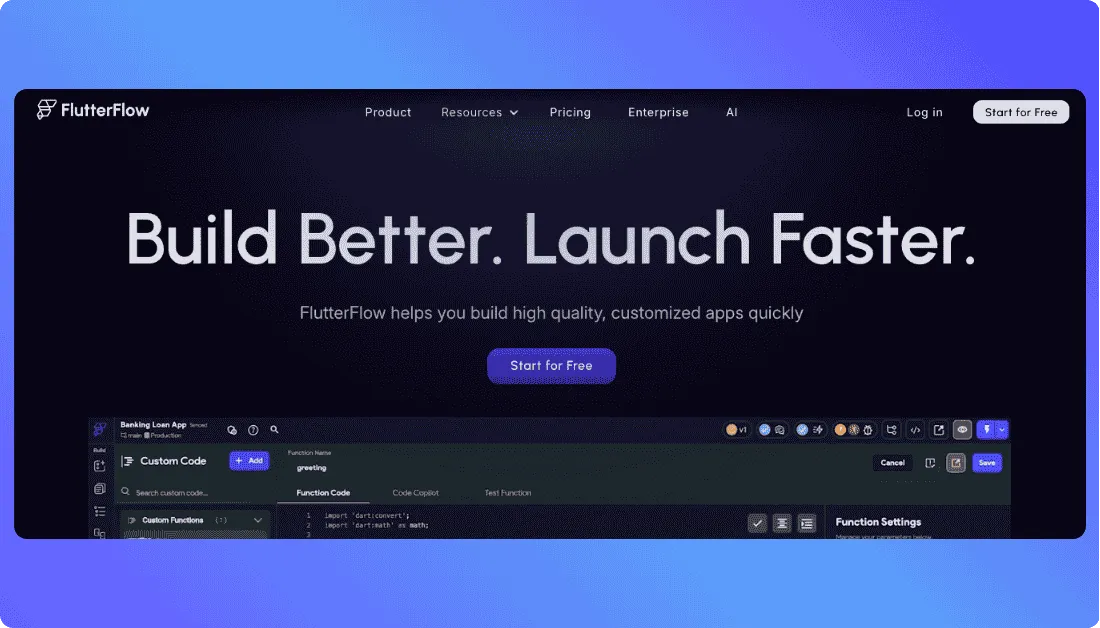
FlutterFlow is the best Rork alternative for visual control and code export, for 3 reasons.
- It builds one Flutter codebase for iPhone, Android and web in a visual editor.
- Code download, APK download and one-click Apple and Google store deployment start on the Basic plan.
- It adds an AI agent on top of the visual canvas, so screens can be built by prompt or by hand.
FlutterFlow is a low-code platform, which means you build mostly by dragging components and add code only where needed. Unlike Bubble, which is web-first, FlutterFlow compiles native mobile apps.
The trade-off is the learning curve. A visual builder gives more control than chat, but it takes longer to learn.
How FlutterFlow Compares to Rork
On control, Rork works through chat, while FlutterFlow lets teams edit every screen directly.
On publishing, both reach the App Store and Google Play. Apple’s $99-per-year membership and Google Play’s one-time $25 fee are not included in any FlutterFlow plan.
Where Rork wins: faster first drafts for non-technical founders who prefer describing an app to designing it.
Key Features of FlutterFlow
- Visual editor: drag-and-drop screens with live preview
- One codebase: iOS, Android and web from one Flutter project
- Code export: full Flutter code from Basic up
- Store deployment: one-click publishing to both stores
- GitHub integration: available from Pro
FlutterFlow Pricing
- Free: up to 2 projects
- Basic: $39 a month, or $29 a month billed yearly
- Pro: $80 a month, or $60 billed yearly, with 2.5 times Basic’s AI usage
- Max: $150 a month
4. CatDoes
Builds: Mobile apps and web apps with a built-in backend
Publishes to: App Store and Google Play (Starter plan and up); web on all plans
CatDoes is the best Rork alternative for a built-in backend on every plan, for 3 reasons.
- Every CatDoes app comes with a full backend covering database, auth, storage and edge functions, with no third-party setup.
- The agent keeps working in the cloud after you close your browser, and it can simulate App Store review before you submit.
- CatDoes handles the build and submission for iOS and Android, so you don’t need Xcode or Android Studio.
Like Replit and Emergent, CatDoes runs its AI agent in the cloud, so long builds do not depend on an open browser tab. CatDoes reports more than 10,000 builders and 11,000 apps.
The trade-off is plan gating. Store publishing starts on Starter, and code export requires the higher Pro plan.
How CatDoes Compares to Rork
On backend, both offer built-in data and auth. CatDoes includes it on the Free plan too.
On code ownership, code export is included on the Pro plan but not on Starter.
Where Rork wins: fully native Swift and Kotlin output.
Key Features of CatDoes
- CatDoes Cloud: backend on every plan
- App Store review simulation: catches issues before submission
- Cloud agent: keeps building after you leave
- GitHub import: bring existing code into a project
CatDoes Pricing
- Free: 1 public project, web deployment, CatDoes Cloud
- Core: $20/month, with yearly billing saving 16%
- Starter: $42/month with 200 credits and iOS and Android deploys (yearly price shown)
- Pro: higher credits, two-way GitHub sync and code export
5. Rocket.new
Builds: Next.js web apps and Flutter mobile apps
Publishes to: Web with one-click deployment; mobile apps through code export and your own store accounts
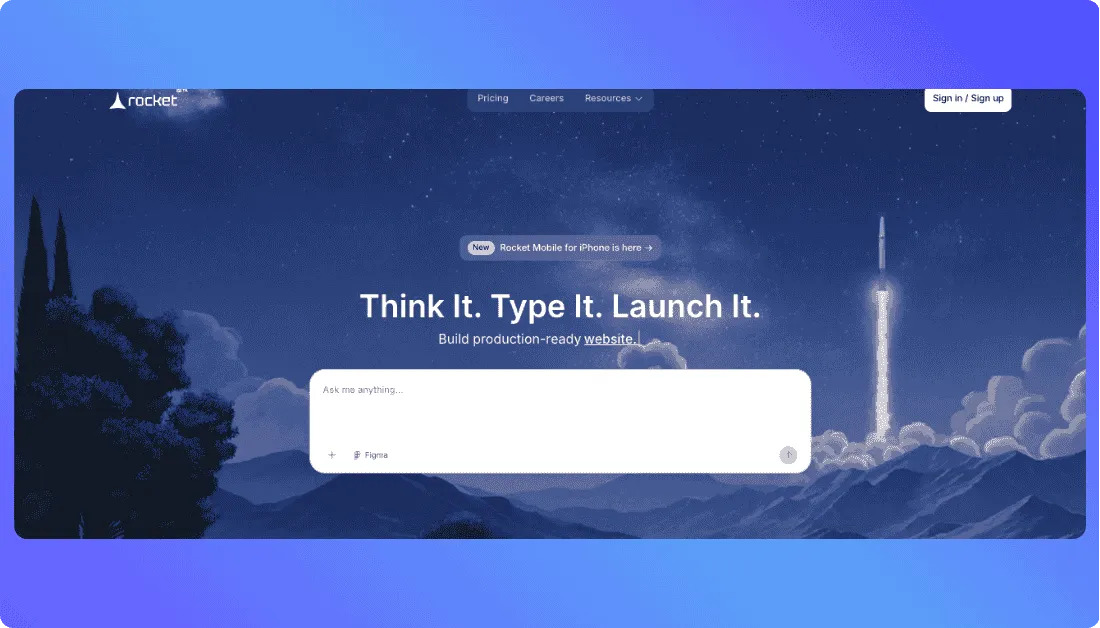
Rocket.new is the best Rork alternative for founders who want a web product and a Flutter mobile app from one platform, for 3 reasons.
- It generates Next.js web apps and Flutter mobile apps from plain-language prompts, with no terminal needed.
- Its web app includes visual editing, code view, connectors and one-click deployment.
- You can download the real code or connect it to GitHub.
Rocket also targets business projects such as SaaS dashboards, internal tools, marketplaces and customer portals. This makes it useful for teams comparing vibe coding tools for enterprises.
The trade-off is store publishing. Publishing to the App Store requires Xcode on a Mac, and Google Play requires building the app with Flutter command-line tools on a computer.
How Rocket.new Compares to Rork
On scope, Rork focuses on mobile apps. Rocket covers web, mobile and landing pages, plus research and competitor monitoring.
On publishing, Rork submits apps for you. Rocket hands you Flutter code, and you complete the store steps yourself.
Where Rork wins: a no-Mac path to the App Store for non-technical founders.
Key Features of Rocket.new
- Two stacks: Next.js for web and Flutter for iOS and Android
- Visual editing: change layouts without prompting
- GitHub sync: connect generated code to a repository
- APK download: test Android builds directly
Rocket.new Pricing
- Free: 20 one-time credits
- Pro:25/month(20/month billed annually) with 100 credits each month
- Rocket:50/month(40/month billed annually) with 250 credits each month
- Booster: $250/month with 1,500 credits each month
For a full overview,
6. Bolt.new
Builds: Full-stack JavaScript web apps; React Native mobile apps through Expo
Publishes to: Web hosting; App Store and Google Play through Expo’s build tools
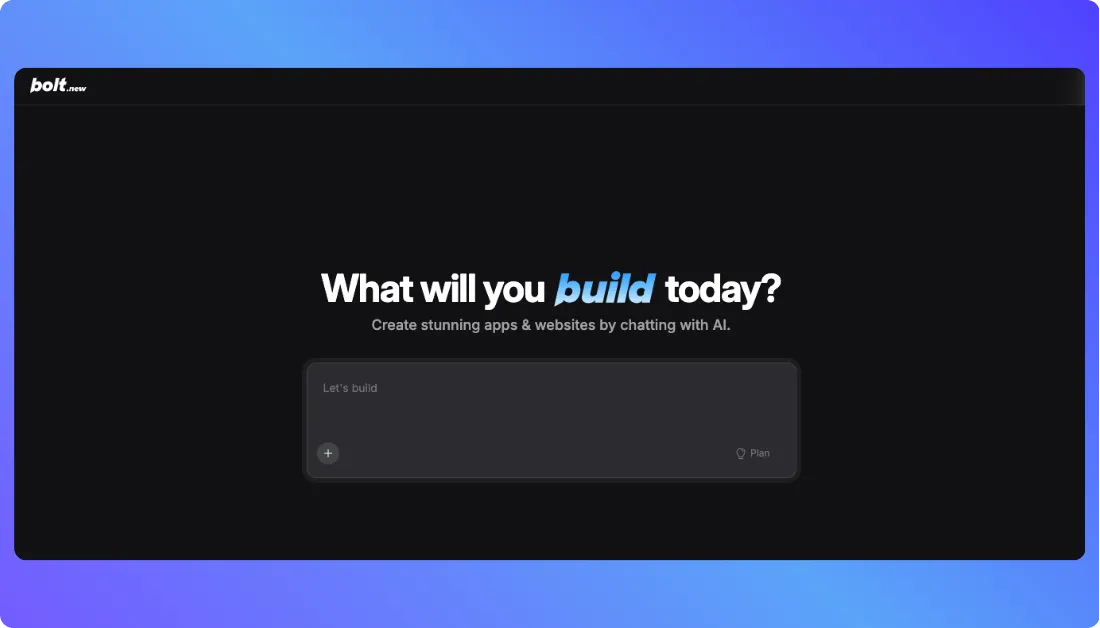
Bolt.new is the best Rork alternative for web-first projects, for 3 reasons.
- Bolt is an AI web development agent that builds web, iOS and Android apps from the browser.
- When you ask for a mobile app, Bolt uses Expo, so the same code runs on iPhone and Android.
- Its free plan renews monthly, which suits testing ideas before paying.
Bolt has a large builder community. Over 90,000 people entered a Bolt.new hackathon. It works well for a SaaS landing page, a dashboard or a client portal.
The trade-off is mobile publishing. Bolt’s mobile path still requires setup. You configure EAS, create signed iOS and Android builds, and submit them through App Store Connect and Google Play Console.
How Bolt.new Compares to Rork
On focus, Rork is mobile-first. Bolt is web-first, with mobile added through Expo.
On pricing, Bolt meters tokens rather than credits, and paid tokens roll over for a limited time.
Where Rork wins: guided App Store submission without command-line steps.
Key Features of Bolt.new
- In-browser IDE: build and edit code without installing anything
- Expo integration: React Native apps for iPhone and Android
- Web hosting: publish web apps directly
- Code export: download the project anytime
Bolt.new Pricing
- Free: 300K daily token limit and 1M tokens per month
- Pro: $25 per month billed monthly, starting at 10M tokens per month with no daily limit
- Teams: $30/month per member, billed monthly
See our
Bolt.new pricing breakdown or how it stacks up in Bolt vs Lovable.
7. Superapp
Builds: Native Swift apps for iPhone, iPad, Apple Watch, Mac and Vision Pro
Publishes to: App Store and Mac App Store (no Android)
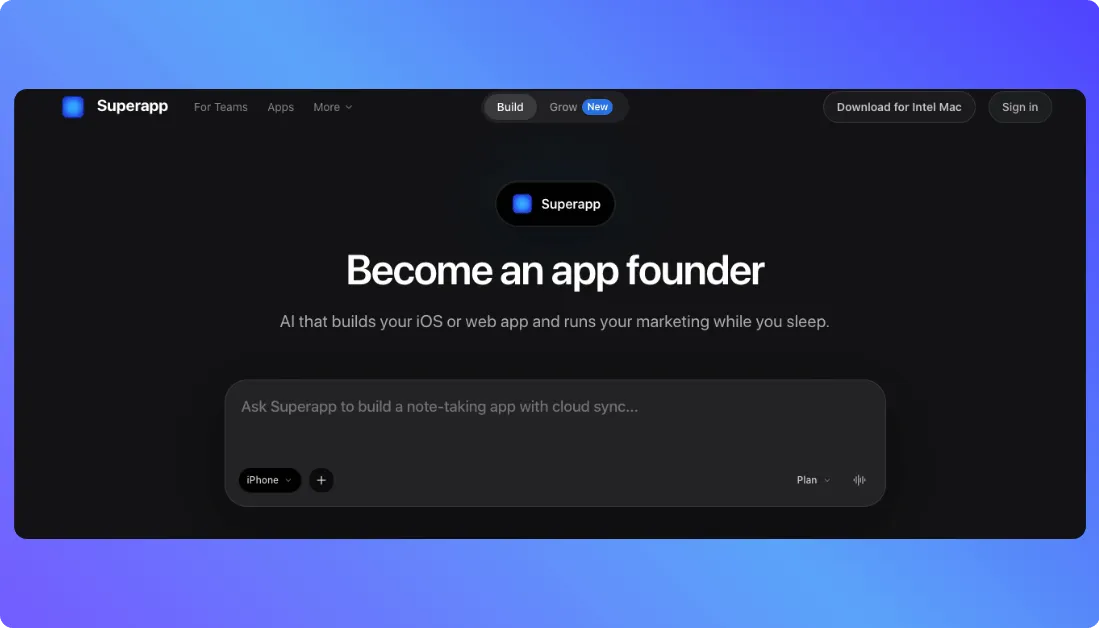
Superapp is the best Rork alternative for Apple-only apps, for 3 reasons.
- It builds native apps for iPhone, iPad, Apple Watch, Mac and Vision Pro from one project.
- It publishes to the App Store with no Mac required.
- You can export the full Xcode project on any plan.
Superapp suits builders who want a companion Watch app or a Mac version, such as a fitness tracker or a habit app. Publishing a Mac app needs a $99-a-year Apple Developer account, the same one required for iPhone apps.
The trade-off is Android. Superapp is open about it: if you need Android or one codebase across iOS and Android, it recommends a cross-platform tool like FlutterFlow.
How Superapp Compares to Rork
On platforms, both build native Swift. Rork also covers Android with Kotlin, while Superapp stays inside the Apple ecosystem.
On code ownership, Superapp includes Xcode export on every plan, including Free.
Where Rork wins: native Android apps.
Key Features of Superapp
- Full Apple coverage: iPhone, iPad, Watch, Mac and Vision Pro
- Native Swift: SwiftUI output, not a web view
- Figma import: turn designs into Swift screens
- Xcode export: own the project on any plan
Superapp Pricing
- Free: 5 credits a day
- Pro: $25 per month with 50 credits
- Business: $50 per month with 110 credits
- Max: $100/month
How to Pick the Right Rork Alternative for Your Team
Picking a Rork alternative is not about finding the “best” tool. It is about finding the one that fits what you are building.
Think About What You’re Building
A consumer app for the App Store needs polished native screens and a smooth review process. Vibecode, Superapp and FlutterFlow fit that goal.
A business app is different. A fitness studio needs a booking app for members and a dashboard for trainers, both reading the same data. Agencies and freelancers building client apps face the same need, which is where a full-stack builder like Vitara.ai fits.
For staff-only tools,
see our Retool review.
Think About Where Your Users Are
If your users are only on iPhone, a native Swift tool makes sense. If you need Android as well, choose a cross-platform builder.
If most users work in a browser, a web-first tool may be enough. Lovable suits web apps, and agencies can build a real estate website in under 2 hours with vibe coding.
Think About Your Budget Realistically
Compare the total cost of your stack, not the sticker price.
Suppose a mobile builder at $20/month covers the app but not your web dashboard. Adding a web builder like Lovable Pro at $25 per month brings you to $45/month. Then add Apple’s $99-per-year membership and Google Play’s one-time $25 fee, all before your first user signs up. Our Lovable pricing guide explains how those credits work.
Think About What Happens After the App Is Built
The build is only the first step. Your app still needs real data, user logins, store review and updates.
Tools that put the web app, mobile app and backend in one project reduce the handoffs. Our Vitara vs Lovable vs Base44 comparison shows how full-stack builders differ on this.
Think About Code Ownership, Not Just Speed
Before you commit, ask these questions:
- Can you download the full code on your plan?
- Do unused credits roll over or reset?
- Can you test on a real phone before publishing?
- Who handles the store submission step?
The safest way to check is a small test. Most tools here offer a free plan, so students and founders can try the same prompt in two tools before paying.
Pick the Rork Alternative That Fits Your Workflow
Each tool on this list solves a different problem.
If you need native Swift for Apple devices, start with Vibecode or Superapp. If you want visual control, try FlutterFlow. If you need a web app, a mobile app and a backend that share the same data, Vitara.ai is the strongest fit.
Rork remains a good choice for native Kotlin Android apps and guided App Store publishing. The best decision comes from testing your own app idea.
Start from a template or a prompt, and see your web and mobile app run on one backend.
Start building with Vitara.ai →
Rork Alternatives: FAQs
What is the best Rork alternative?
It depends on your app. Vitara.ai is best for full-stack business apps on web and mobile. Vibecode is best for native Swift iPhone apps, and FlutterFlow is best for visual building with code export.
How much does Rork cost?
Rork offers a free plan, with paid plans ranging from $20 to $1,800 per month. In India, plans start at ₹649 (about $8) per month. Check Rork's official page for the latest pricing.
Is there a free Rork alternative?
Yes. Vitara.ai's Starter plan includes 10 credits. Bolt.new's free plan includes 1M tokens per month, and Superapp's free plan gives 5 credits a day. FlutterFlow's free plan allows up to 2 projects.
Does Rork still build React Native apps?
New Rork projects use native code. Rork builds native iOS apps in Swift, Android apps in Kotlin, and web apps. Teams that want React Native + Expo can use Vitara.ai, Bolt.new or Vibecode's mobile app option.
Which Rork alternative builds both web and mobile apps?
Vitara.ai, Rocket.new, Bolt.new, FlutterFlow and CatDoes all build both. Vitara.ai puts both on one shared backend, which helps businesses like restaurants and online stores. See how it compares in Replit vs Lovable vs Vitara.
Are there other Rork alternatives worth trying?
Yes. Newly, Anything, Adalo and RapidNative also build mobile apps, and our RapidNative vs Emergent comparison covers two of them. For web apps, explore Lovable alternatives, Glide, Firebase Studio or Emergent alternatives.
What’s New?