7 Best a0.dev Alternatives and Competitors for 2026
a0.dev is a capable AI mobile app builder.
It turns chat prompts into React Native apps, publishes them to the App Store and Google Play, and adds payments and analytics on top.
But it is not the right fit for every project.
If you also need a web dashboard, a backend you control, or ready-made business apps, the best a0.dev alternatives are Vitara.ai for mobile and web apps on one backend, Rork for native iPhone and Android apps, and FlutterFlow for visual design control.
One quick note: a0.dev is not Vercel’s v0. The names look alike, but v0 builds web interfaces, while a0.dev builds mobile apps.
Below are the 7 a0.dev alternatives worth comparing, with their features, pricing, and trade-offs.
TL;DR: Top 3 a0.dev Alternatives
If you are short on time, here are the top 3 picks:
Vitara.ai (Best overall)
The best a0.dev alternative when you need a mobile app and a web app that share one backend and database. It has a free plan, and paid plans start at $20/month.
Rork
The best pick for native iPhone apps in SwiftUI and Android apps in Kotlin. Rork Max starts at $20/month for 100 credits, and the free plan covers app design only.
FlutterFlow
The best choice for teams that want visual control over every screen. It has a free plan, and the Basic plan starts at $39/month.

Vitara builds the React Native app, the web app, the API, and the database together, so all your data stays in one place.
Start building with Vitara.ai →
A Quick Comparison of 7 a0.dev Alternatives at a Glance
Here is a side-by-side look at all 7 a0.dev competitors, so you can spot the differences quickly. Prices are in USD and billed monthly unless noted.
| Tool | Builds | Starting Price | Best For | Code Ownership |
|---|---|---|---|---|
| 1. Vitara.ai | Web, mobile (React Native + Expo), full-stack | Free plan; $20/mo | Mobile + web apps on one backend | Download code (Build plan) |
| 2. Rork | iPhone (SwiftUI), Android (Kotlin), web | Free (design only); $20/mo | Native mobile apps | Edit code in Dev mode (paid) |
| 3. FlutterFlow | iOS, Android, web (Flutter) | Free plan; $39/mo | Visual, design-controlled apps | Code export on paid plans |
| 4. Replit | Web and mobile apps in a cloud IDE | Free plan; 20/mo(18 annual) | Developers who want full code access | Full code access |
| 5. Bolt.new | Web apps | Free (1M tokens/mo); $25/mo | Fast web prototypes | Code export |
| 6. RapidNative | iOS, Android (React Native + Expo) | Free (20 credits/mo); $20/mo | React Native code for developer handoff | Code export from $20 plan |
| 7. Lovable | Web apps | Free plan; $25/mo | Polished web apps | GitHub sync |
Why Are Users Looking for a0.dev Alternatives?
a0.dev does a few things very well. Its publishing flow handles the build, creates your App Store Connect listing, and uploads the app for you. For a first-time founder, that removes hours of setup.
But a few clear patterns explain why teams start comparing other options.
- It is built for mobile first. Many business apps need two sides: a customer app and a staff dashboard. A gym owner, for example, wants a member app for class bookings and a fitness business website with a front-desk check-in screen. a0.dev focuses on the phone side.
- Usage-based pricing is hard to predict. Like most vibe coding tools, a0.dev charges for AI usage, so every bug fix and follow-up prompt counts. [VERIFY: a0.dev Pro price and daily message limit from a0.dev/pricing] A vague prompt can take several rounds to get right, and each round uses part of your allowance.
- The backend lives in another service. a0.dev connects to Convex or Supabase for the database. That is one more account to manage, and possibly one more bill as your user base grows.
- There are no ready-made business app starters. An HR team that needs leave tracking and payroll screens has to describe every screen from scratch. Chat-based AI app builders with complete templates skip that step.
These are not criticisms of a0.dev as a product. It is a matter of fit. If your project needs more than a mobile app, the vibe coding platforms below are worth comparing.
7 Best a0.dev Alternatives and Competitors
Here is a closer look at what each tool does well, where it falls short, and what it costs.
1. Vitara.ai
Builds: Web apps (React), mobile apps (React Native + Expo), and full-stack apps
Backend: Python or Node.js with a MongoDB database, included
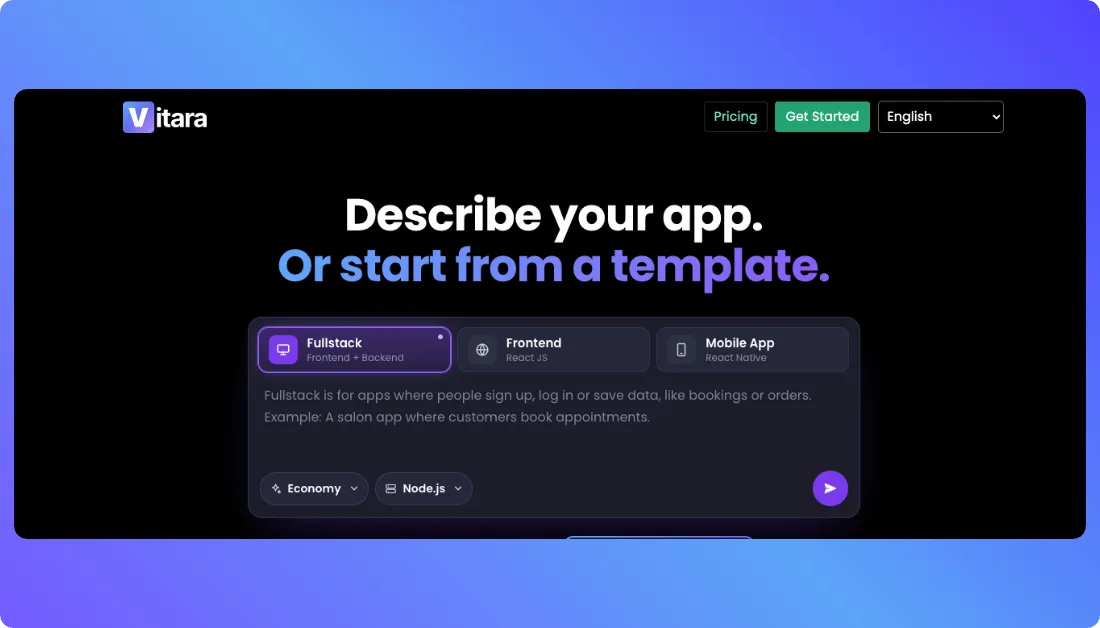
Vitara.ai is the best overall a0.dev alternative for 4 clear reasons.
It builds your mobile app and web app on one shared backend and database, so a customer app and a staff dashboard always show the same data.
It offers complete app templates with screens, backend, database, and login already built.
Its Economy Mode uses a smaller model for everyday edits, so each message uses fewer credits.
You own your code and data, and you can download the code and deploy it anywhere.
Vitara.ai’s chat-based app builder
Templates and Economy Mode together can cut credit use by up to about 66%. A booking app MVP takes roughly 60 credits from scratch, about 40 from a template, and about 20 with a template plus Economy Mode.
Every message updates the screens, API, and database together, so one request changes the full stack at once.
Picture a dental clinic that needs a patient booking app and a reception dashboard. Starting from the Appointment Booking template, the clinic gets both on one database, then tests the mobile app on a real phone by scanning a QR code with the free Expo Go app.
Non-technical builders use it too. Dr. Gaurav Patel, a gastro surgeon with no technical background, built a patient survey system with Vitara.
How Vitara.ai Compares to a0.dev
a0.dev is a mobile-first builder. Vitara covers mobile, web, and the backend in one project.
On platforms, Vitara builds React web apps and React Native mobile apps from the same project. a0.dev focuses on mobile.
On backend, Vitara includes the API and database, with no third-party backend to set up. a0.dev connects to Convex or Supabase.
On cost control, templates and Economy Mode lower the credits each feature takes, which matters when you iterate a lot.
Where a0.dev wins is its publishing pipeline. If one-click App Store submission, built-in monetization, and growth analytics are your top priorities, a0.dev is hard to beat.
See how Vitara stacks up
against two popular builders in our Replit vs Lovable vs Vitara.ai comparison.
Key Features of Vitara.ai
- Three build types: Fullstack, Frontend (React), and Mobile App (React Native + Expo)
- Shared backend so web and mobile apps use one API and database
- Ready-made templates such as CRM, HRMS, Event Ticketing, and Billing with GST/e-invoicing
- Economy Mode for lower-cost everyday edits
- Visual Edits to adjust the UI directly (Build plan)
- Code download to deploy anywhere (Build plan)
- One-click publishing from $5/month
Vitara.ai Pricing
Vitara uses monthly credits across three plans.
- Starter – Free – 10 credits total, free templates, Economy Agent
- Build – $20/month – 100 credits/month, no daily limit, Free + Standard templates, Advanced Agents, Visual Edits, code download, custom domain
- Scale – $50/month – 250 credits/month, all templates including Premium, team collaboration, higher limits
Important: Like any AI-generated app, test login, payments, permissions, and integrations before launch. Our guide to secure vibe coding covers what to check.
Pick a ready-made CRM, booking, or HRMS app, then customize it in chat with Economy Mode to keep credit use low.
Start building with Vitara.ai →
2. Rork
Builds: Native iPhone apps (SwiftUI), Android apps (Kotlin + Compose), and web apps
Starting price: Free plan (design only); Rork Max from $20/month
Rork is the best a0.dev alternative for native mobile apps, and here is why.
It writes native Swift for iPhone and Kotlin for Android, rather than one cross-platform codebase.
It reaches iPad, Apple Watch, and Vision Pro on Rork Max, plus native games and iOS widgets.
- It includes an AI App Store Reviewer that helps catch likely rejections before you submit.
Rork splits the work into two modes. Design mode explores screens for free, and Build mode turns them into a working app on a paid plan.
Picture a solo founder building a subscription habit tracker for iPhone. Native SwiftUI code gives the app a true iOS look and feel.
The trade-off is cost at scale. Credits pay for both building and in-app AI features, and unused plan credits do not roll over.
How Rork Compares to a0.dev
Rork is a0.dev’s closest rival. Both are mobile-first builders aimed at founders who want to publish to the app stores.
On code, Rork now generates native Swift and Kotlin. a0.dev generates React Native, one codebase for both platforms.
On platforms, Rork reaches Apple’s wider device range, including Apple Watch and Vision Pro.
Where a0.dev wins is simplicity of maintenance. One React Native codebase is easier for a small team to update than two native ones.
For more AI tools
that write real, editable code, see our list of top AI coding tools.
Key Features of Rork
- Design mode to explore app screens for free
- Build mode for native SwiftUI and Kotlin apps
- Rork Backend for real-time data, authentication, and storage
- Rork AI Cloud for AI, search, images, and voice inside your apps
- Dev mode to edit the underlying code
Rork Pricing
- Free – $0 – Design mode only, up to 35 design credits/month in major markets
- Rork Max – from $20/month for 100 credits, scaling to $200 (1,000), $500 (2,500), $900 (5,000), and $1,800 (10,000)
- Rork Start – ₹649/month, India only – 40 credits/month, light models
Extra credits cost $0.22 each on paid plans. Check Rork’s pricing page for the latest plans, since they changed in November 2026.
3. FlutterFlow
Builds: iOS, Android, and web apps with Flutter
Starting price: Free plan; Basic at $39/month
FlutterFlow is the best a0.dev alternative for visual design control, and here is why.
It pairs a prompt-based app builder with FlutterFlow Studio, a visual editor for fine-tuning every screen.
One subscription covers both, since each plan includes a matching Studio plan at no extra cost.
It builds on Flutter, Google’s framework for iOS, Android, and web apps from one codebase.
Picture an agency that must match a client’s Figma design exactly. Describing the app produces a first version fast, and Studio lets a designer adjust spacing, fonts, and layouts by hand.
The trade-off is the learning curve. Studio is powerful, but it takes longer to learn than a pure chat builder.
How FlutterFlow Compares to a0.dev
On design control, FlutterFlow gives you a full visual editor. a0.dev relies mainly on chat prompts.
On code, FlutterFlow outputs Flutter (Dart). a0.dev outputs React Native (JavaScript), which more web developers already know.
Where a0.dev wins is simplicity for beginners. There are fewer panels to learn before you publish.
See how FlutterFlow compares
with other builders in our Codev alternatives roundup.
Key Features of FlutterFlow
- AI agent that builds a first version from your description
- One free first build on every account
- FlutterFlow Studio for visual, screen-by-screen editing
- Cross-platform output for iOS, Android, and web
- Paid refills on Pro and Max when your allowance runs low
FlutterFlow Pricing
- Free – $0 – one free first build, then a small weekly allowance
- Basic – $39/month – allowance sized for a simple app
- Pro – $80/month – 2.5 times the Basic allowance
- Max – $150/month – 5 times the Basic allowance
These are US monthly list prices. Regional prices can be lower.
4. Replit
Builds: Web and mobile apps in a browser-based development environment
Starting price: Free Starter plan; Core at 20/month(18 billed annually)
Replit is the best a0.dev alternative for people who want full code access, and here is why.
Replit Agent builds apps from prompts inside a full cloud IDE, so you can open and edit every file.
It includes built-in databases, user authentication, and hosting.
Core supports up to 5 collaborators without a separate team plan.
Picture a technical founder who wants AI speed but still plans to edit code by hand. Replit fits, because the agent and the code editor sit in the same workspace.
The trade-off is cost predictability. Replit uses effort-based pricing, so a complex request costs more than a simple one.
How Replit Compares to a0.dev
On control, Replit is a full development environment. a0.dev keeps most of the code behind a chat interface.
On scope, Replit handles web apps, APIs, and scripts. a0.dev focuses on mobile apps.
Where a0.dev wins is focus. Everything in a0.dev is built around shipping a mobile app, so beginners face fewer choices.
Want the full cost picture?
Read our guide to Replit pricing, or see how it stacks up in Bolt.new vs Replit.
Key Features of Replit
- Replit Agent for building and editing apps from prompts
- Plan Mode to map out a build before the agent writes code
- Built-in database, auth, and hosting in one workspace
- Team collaboration for up to 5 builders on Core and 15 on Pro
Replit Pricing
- Starter – Free – limited Agent access
- Core – $20/month, or $18/month billed annually – usage credits equal to the plan price
- Pro – $100/month, or $90/month billed annually – up to 15 builders, pooled credits
- Enterprise – Custom
Core credits expire at the end of each billing cycle, so unused credits are lost.
5. Bolt.new
Builds: Web apps in the browser
Starting price: Free (1M tokens/month); Pro at $25/month
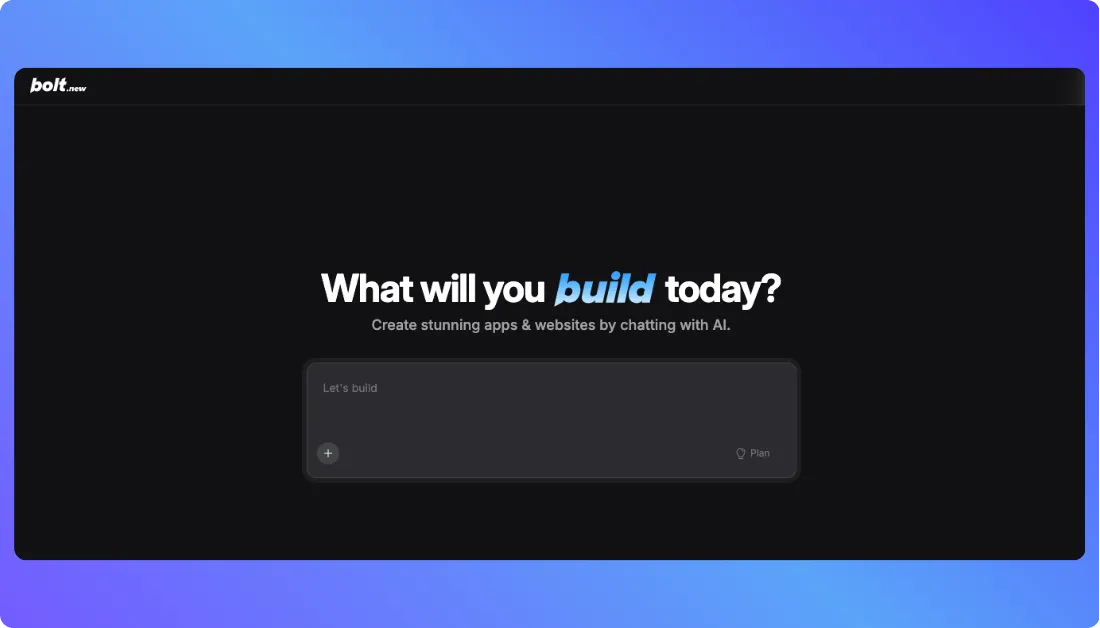
Bolt.new is the best a0.dev alternative for fast web prototypes, and here is why.
It runs a full development environment in the browser, so there is nothing to install.
The free plan includes 1M tokens a month, enough to test small ideas.
Pro removes the daily token limit, and unused tokens roll over on paid plans.
Picture a product manager who needs a clickable demo before Friday’s meeting. Bolt.new can turn one prompt into a working web app in a single session.
The trade-off is token use on bigger projects. As the codebase grows, each request processes more code and uses more tokens.
How Bolt.new Compares to a0.dev
On platform, Bolt.new focuses on web apps. a0.dev focuses on mobile apps.
On pricing, Bolt.new meters tokens, which is easy to track per plan but harder to predict per feature.
Where a0.dev wins is mobile. If your users live on their phones, a0.dev is the better fit.
See how Bolt.new compares
with a full-stack builder in our Bolt.new vs Vitara.ai breakdown.
Key Features of Bolt.new
- In-browser IDE with live preview
- Website hosting included on every plan
- Token rollover on paid plans
- Teams plan for shared workspaces
Bolt.new Pricing
- Free – $0 – 1M tokens/month, 300K daily limit
- Pro – $25/month – 10M tokens/month, no daily limit
- Pro 50 – $50/month – 26M tokens/month
- Teams – $30/member/month
- Enterprise – Custom
For a full breakdown,
read our guide to Bolt.new pricing.
6. RapidNative
Builds: iOS and Android apps with React Native and Expo
Starting price: Free (20 credits/month); Starter at $20/month
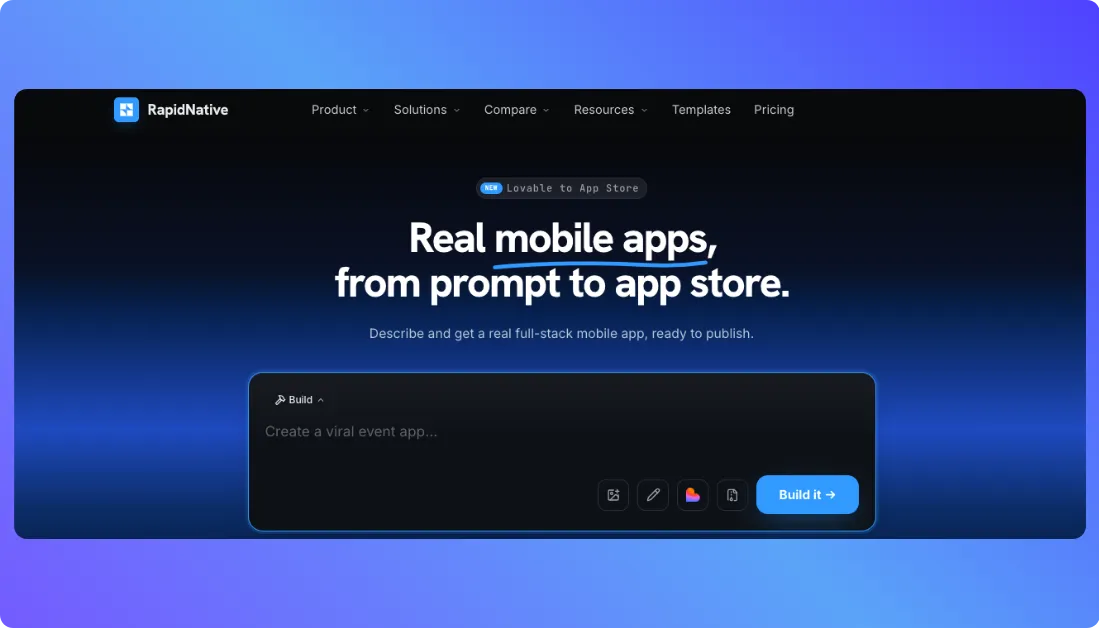
RapidNative is the best a0.dev alternative for React Native code you can hand to developers, and here is why.
It generates React Native and Expo code, the same stack many mobile teams already use.
It includes code export from the $20 Starter plan, so the project can move to your own repository.
It accepts several kinds of input, including plain-English prompts, images, and product requirement documents.
Picture a startup that will hire an in-house mobile team next year. RapidNative fits, because developers can pick up standard React Native code instead of learning a new framework.
The trade-off is scope. RapidNative focuses on the mobile app, so a web dashboard for staff needs another tool.
How RapidNative Compares to a0.dev
On code, both tools generate React Native. RapidNative puts more emphasis on clean, exportable components.
On publishing, RapidNative offers a separate deployment service that builds and submits apps to both stores.
Where a0.dev wins is the all-in-one flow, with payments and analytics included in one platform.
Read our
Full RapidNative review, or see how it compares in RapidNative vs Emergent.
Key Features of RapidNative
- Prompt, image, and PRD-to-app generation
- Live phone preview while you build
- Code export on paid plans
- Backend connections through services such as Supabase
RapidNative Pricing
- Free – $0 – 20 credits/month (up to 5 per day), public projects
- Starter – $20/month – 50 credits, code export
- Pro – $49/month – 150 credits
- Max – $99/month – 330 credits
Annual billing lowers the monthly cost.
7. Lovable
Builds: Web apps
Starting price: Free plan; Pro at $25/month
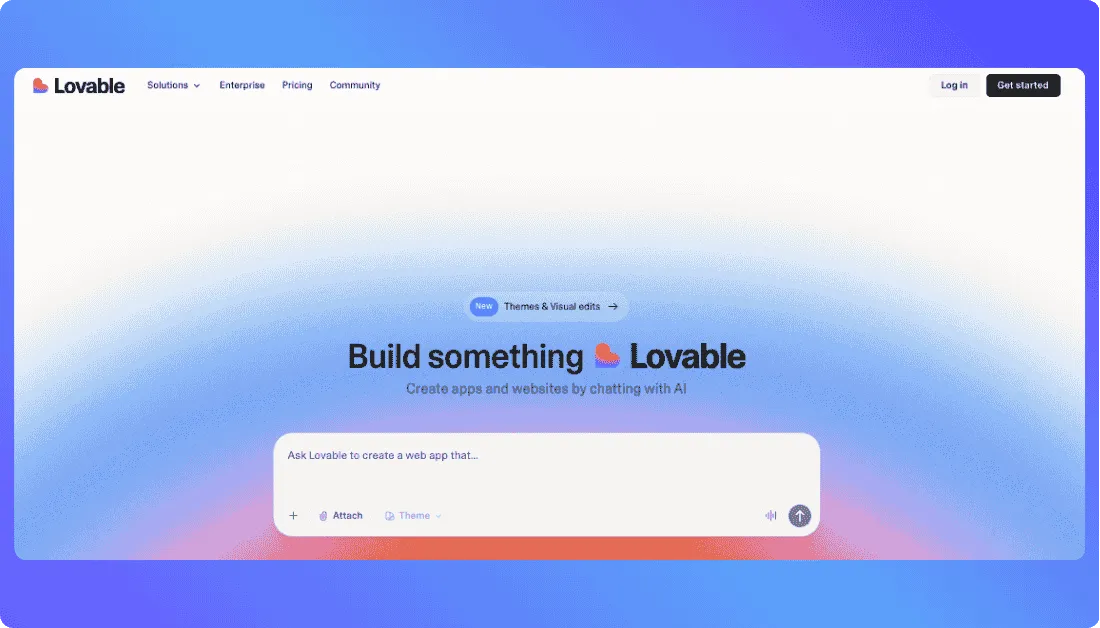
Lovable is the best a0.dev alternative for polished web apps, and here is why.
It turns prompts into well-designed web interfaces with very little cleanup.
Pro credits are shared across unlimited users, so a whole team works under one plan.
Its Lovable Cloud backend handles the database and hosting for your app.
Picture a SaaS founder whose customers all work on laptops.Lovable gives that founder a clean product UI fast, without a mobile app in the plan.
The trade-off is platform reach. Lovable builds web apps, not native mobile apps, so it only replaces a0.dev if you drop the mobile requirement.
How Lovable Compares to a0.dev
On platform, Lovable is web-first. a0.dev is mobile-first.
On team pricing, Lovable charges by credits, not seats, which keeps costs flat as you add teammates.
Where a0.dev wins is anything that must live in the App Store or Google Play.
Comparing web builders?
See Lovable vs Bolt vs v0 or our list of Lovable alternatives.
Key Features of Lovable
- Prompt-to-web-app generation with strong visual design
- Lovable Cloud for backend and hosting
- Credit rollovers and on-demand top-ups on paid plans
- Custom domains and badge removal on Pro
Lovable Pricing
- Free – $0 – 5 daily credits, up to 30 per month
- Pro – $25/month (about $21/month billed annually) – 100 credits/month
- Business – $50/month (about $42/month billed annually) – 100 credits/month plus team controls
- Enterprise – Custom
Pro top-ups cost $15 per 50 credits.
For more detail,
read our guide to Lovable pricing.
Other a0.dev Competitors Worth a Look
A few more tools come up often in a0.dev comparisons. Vercel’s v0 generates web interfaces, not mobile apps. Bubble is a mature no-code platform for web apps. Fastshot and Newly are newer AI mobile app builders that generate React Native apps and help with store publishing.
How to Pick the Right a0.dev Alternative for Your Project
The right choice depends on where your users are, your budget, and who will maintain the app after launch.
Picking an a0.dev alternative is not about finding the “best” tool. It is about finding the one that fits how your project actually works.
Think About Where Your Users Are
If your users only open the app on a phone, a mobile-first builder like Rork or RapidNative covers you well.
If staff or customers also need a browser view, choose a tool that builds both. A hotel, for example, needs a guest booking app and a front-desk dashboard that read the same reservations.
Think About Your Budget Realistically
Do not compare only the sticker price. Compare the total cost of your app stack.
A builder plan might cost $20 to $25 a month. Add a separate backend service that may move to a paid tier as you grow, Apple’s $99 yearly developer fee, and Google Play’s $25 one-time registration fee. A tool with the backend included removes one of those bills.
Also check how credits work. Some plans roll unused credits over, while others reset them every month.
Think About What Happens After Launch
Ask who will maintain the app in a year. If you plan to hire developers, choose a tool with clean code export in a common stack, such as React or React Native.
Larger teams should also check access controls and collaboration limits, which our guide to vibe coding tools for enterprises covers in detail.
Think About Your Switching Risk
Before you move a live app, ask these questions.
- Can I export my code and data today?
- Who owns the App Store and Google Play accounts?
- Will login and payments need re-testing on the new platform?
- Do my unused credits carry over, or are they lost?
The best way to judge any builder is to test it. Most tools on this list have a free plan, so build one small feature in each and compare the results.
Pick the a0.dev Alternative That Fits Your Project
Each tool on this list solves a different problem, so the best approach is to match the tool to your project.
If you need a mobile app and a web dashboard on one backend, start with Vitara.ai. If you want native iPhone and Android code, choose Rork. If design control matters most, try FlutterFlow. Developers who want full code access will feel at home in Replit.
An app is only useful if your whole team can work with it. Tools that keep the app, the dashboard, and the data together save you from stitching services together later. Freelancers building for several clients can see more options in our guide to the best AI tools for building web apps.
Start from a ready-made template and build your mobile and web app on one backend, free.
Start building with Vitara.ai →
a0.dev Alternatives: FAQs
What is the best a0.dev alternative?
It depends on your project. Vitara.ai is the best overall a0.dev alternative when you need mobile and web apps on one shared backend. Rork is best for native iPhone and Android code, and FlutterFlow is best for visual design control.
How much does a0.dev cost?
a0.dev lists several plans on its pricing page, and you can upgrade or downgrade at any time. [VERIFY: insert current a0.dev plan names and prices from a0.dev/pricing] Check the official page before you buy, since AI builder pricing changes often.
Is there a free a0.dev alternative?
Yes. Vitara.ai, Lovable, Bolt.new, RapidNative, Replit, and FlutterFlow all offer free plans with limited credits. Rork's free plan covers app design only, and building a working app requires Rork Max from $20/month.
Is a0.dev the same as Vercel's v0?
No. a0.dev is an AI mobile app builder that generates React Native apps for iOS and Android. Vercel's v0 generates web interfaces and web apps. The similar names often cause confusion in search.
a0.dev vs Rork: which is better for App Store publishing?
Both are built for publishing. a0.dev handles the build, creates your App Store Connect listing, and uploads the app for you. Rork generates native Swift code and includes an AI App Store Reviewer to catch likely rejections early.
Which a0.dev alternative builds both a mobile app and a web app?
Vitara.ai builds a React Native mobile app and a React web app that share one backend and database. Rork and Replit can also build for web and mobile. Lovable and Bolt.new focus on web apps.