5 Best AI Website Builders for Restaurants in 2026
Building a restaurant website sounds simple until you actually sit down to do it.
You need more than a homepage with a few food photos.
Your menu needs to be easy to update. Customers should find your hours and location instantly. Reservations and online ordering should not send them through a confusing maze of pages.
And everything has to work properly on mobile.
That is where AI website builders for restaurants are becoming useful.
Instead of designing every page manually, newer AI builders can generate layouts, write website copy, create menu sections, and help connect booking or ordering workflows from a simple prompt.
But they are not all built for the same type of restaurant.
Some focus on ready-made restaurant features. Others give you more control to build custom functionality.
So I compared five popular options based on what actually matters when building a restaurant website: AI generation, menus, reservations, online ordering, local SEO, customization, mobile experience, and pricing.
Here is what I found.
Quick Comparison: 5 Best AI Website Builders for Restaurants at a Glance
If you do not want to read every review, start here.
| AI Website Builder | Best For | Restaurant Features | Customization |
|---|---|---|---|
| Vitara.ai | Custom restaurant websites and workflows | Custom menus, forms, booking and ordering integrations | High |
| Wix Restaurants | Built-in restaurant management features | Menus, reservations, ordering, payments | High |
| Zarla | Fast website creation and local SEO | Business pages, local SEO, lead management | Moderate |
| Owner.com | Restaurants focused on direct online orders | Ordering, restaurant marketing and SEO | Moderate |
| Manus | AI-led research and custom generation | Menus, ordering and reservation workflows | High |
The main difference is not simply how quickly these tools can generate a website.
It is what happens after the website is generated.
For example, a restaurant that only needs a menu, opening hours, location, and reservation button has very different requirements from a restaurant building custom ordering flows, catering forms, loyalty programs, or multiple locations.
That distinction matters when comparing the best restaurant website builders.
If you are also exploring AI-powered site creation outside the restaurant industry,
Our guides to AI ecommerce website builders and AI tools for building travel websites show how the same technology handles more complex transactional websites.

Create custom menus, booking flows, order forms, catering requests, and restaurant workflows from simple AI prompts.
Start Building with Vitara.ai →
How I Evaluated These AI Restaurant Website Builders
I kept the comparison practical.
Instead of focusing only on who has the flashiest AI generator, I looked at how each platform would handle a typical independent restaurant website.
Think of an Italian restaurant with one location.
It needs a lunch and dinner menu, opening hours, a gallery, Google Maps, a reservation option, pickup ordering, contact information, and pages that work properly on a phone.
I evaluated each AI restaurant website builder around these areas:
- AI generation: How much of the initial website can AI create?
- Menu management: Can a restaurant display and update food, prices, and categories easily?
- Reservations: Is booking built in, integrated, or something you need to create?
- Online ordering: Can customers place orders directly or connect to another ordering system?
- Local SEO: Does the platform help restaurants appear in location-based searches?
- Mobile experience: Are menus, buttons, forms, and navigation usable on smaller screens?
- Customization: How far can you go beyond the generated design?
- Integrations: Can you connect external tools, APIs, databases, or restaurant software?
- Ease of updates: Can staff change hours, menus, promotions, and other information quickly?
- Pricing: What does it actually cost once you need a usable restaurant website?
I also paid attention to how much control the restaurant keeps over the final product.
That becomes particularly important with newer vibe coding tools, where AI can build significantly more than a traditional drag-and-drop page.
What Does a Restaurant Actually Need From an AI Website Builder?
A good restaurant website has a very simple job.
It should help someone decide where to eat, what to order, and what to do next.
That means the best AI website builders for restaurants need to get five things right.
1. A Menu People Can Actually Read
Your menu is usually one of the first things visitors look for.
It should load quickly, work on mobile, and be easy to update whenever dishes or prices change.
Uploading a PDF and calling it finished is rarely the best experience.
A proper restaurant website builder with menu functionality should let customers browse categories without pinching, zooming, or downloading files.
2. Reservations Without Friction
If you take table bookings, the Book a Table option should be obvious.
Some platforms include reservation tools directly.
Others let you connect third-party booking systems or create your own workflow.
For restaurants with unusual booking requirements, an AI platform capable of building custom logic can be more useful than a fixed template. The same idea applies to other booking-heavy businesses, which is why tools such as an AI hotel website builder need more than attractive landing pages.
3. Online Ordering That Matches Your Business
“Online ordering” can mean several different things.
One builder may include checkout directly.
Another may connect to an outside ordering service.
A more flexible platform may let you build a custom flow around your own requirements.
Restaurants should know which one they are getting before they choose a platform.
4. Strong Local SEO
People rarely search for a restaurant without location intent.
They search for things such as Italian restaurant near me, best sushi in Austin, or late-night pizza downtown.
Your website therefore needs clear location information, fast pages, mobile optimization, and search-friendly content.
5. Easy Updates After Launch
Restaurant websites change constantly.
Hours change.
Menus change.
Seasonal dishes disappear.
Promotions come and go.
The best no-code restaurant website builder is not simply the one that gets your site online fastest.
It is the one your team can continue using after launch without needing a developer every time the dinner menu changes.
That is also why understanding vibe coding matters: AI website creation is moving from selecting templates toward describing what you want and letting the system build the experience around it.
Next, we will compare the five builders individually, starting with Vitara.ai and Wix Restaurants.
Best AI Website Builders for Restaurant Websites + Custom Workflows
If you want more than a good-looking menu page, the first two builders are where the comparison gets interesting.
Vitara.ai focuses more on custom websites, workflows, and backend functionality, while Wix gives restaurants a large set of ready-made business tools.
1. Vitara.ai — Best for Custom Restaurant Websites and Full-Stack Workflows
Vitara.ai — Recommended
Most restaurant website builders start by asking you to pick a template.
Vitara takes a different route.
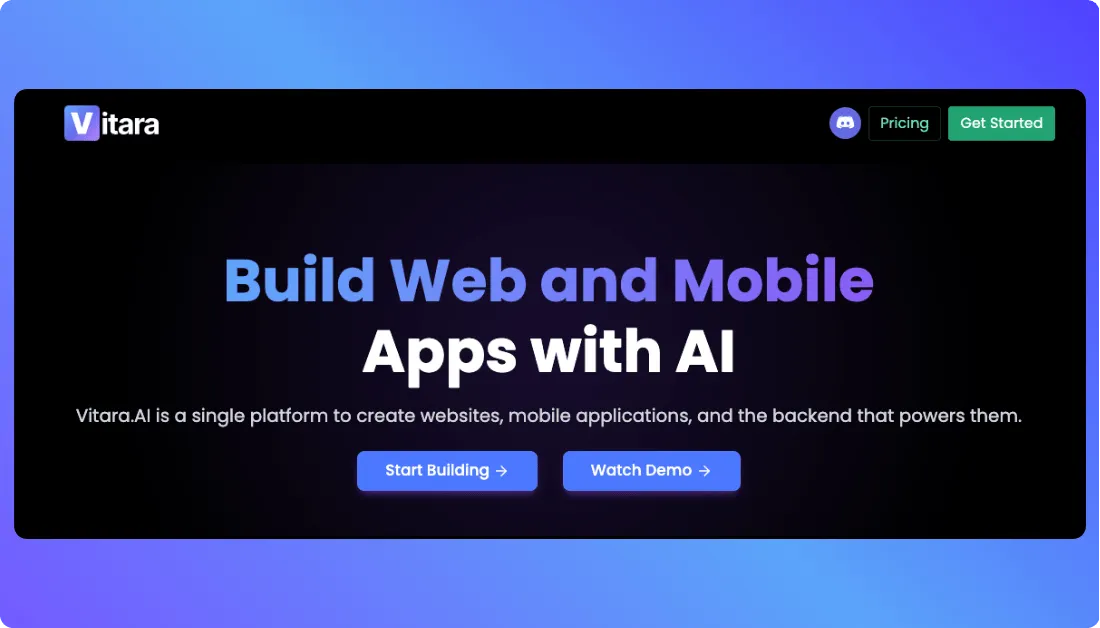
You describe the restaurant website you want in plain English, and Vitara can generate the frontend, backend, pages, and functionality around that prompt.
That makes it particularly useful when your restaurant needs something more customized than a standard menu + contact + reservation website.
For example, you could build a restaurant site with separate lunch and dinner menus, a catering inquiry form, private-event requests, customer accounts, or custom ordering workflows.
The same approach is already used in Vitara’s AI eCommerce website builder, where prompts can generate product listings, checkout flows, customer accounts, order dashboards, APIs, and other commerce functionality.
That flexibility is the biggest difference here.
Vitara generates a React frontend and Node.js backend and supports APIs, custom workflows, editable source code, and code export on applicable paid plans.
So you are not limited to whatever restaurant features a template provider decided to include.
Want a catering form that sends different requests to different staff members?
You can build that workflow.
Need a custom reservation request instead of a standard booking widget?
That can become part of the website logic too.
And if online ordering is important, you can build commerce functionality or connect external services rather than simply adding an “Order Online” button that sends visitors somewhere else.
This is closer to the broader idea of full-stack AI app building than traditional drag-and-drop website creation.
You can also continue refining the project conversationally,
which is useful if you prefer the workflow covered in our guide to chat-based AI app builders.
Key Restaurant Website Features
- Prompt-based website and web app generation
- React frontend with Node.js backend
- Custom menu, catering, reservation, and inquiry workflows
- API and third-party service integrations
- Customer accounts and database-driven functionality
- Editable and downloadable source code on supported plans
- Custom domains on paid plans
- Built-in hosting and continued prompt-based editing
Pricing
Vitara currently offers:
- Starter: $0 with limited credits
- Build: $20/month with 100 monthly credits, custom domain support, faster processing, and code editing/download
- Scale: $50/month with 250 monthly credits
- Custom: Available for larger requirements
Best fit: Restaurants, agencies, or hospitality businesses that want a custom AI restaurant website builder with room for unique workflows, integrations, and backend functionality.
Build restaurant websites with custom menus, reservation requests, online ordering flows, backend logic, and API integrations.
Build with Vitara.ai →
2. Wix Restaurants — Best for Built-In Restaurant Operations
Wix takes almost the opposite approach.
Instead of giving you a blank canvas for building restaurant functionality from scratch, it provides a mature set of restaurant tools that already work together.
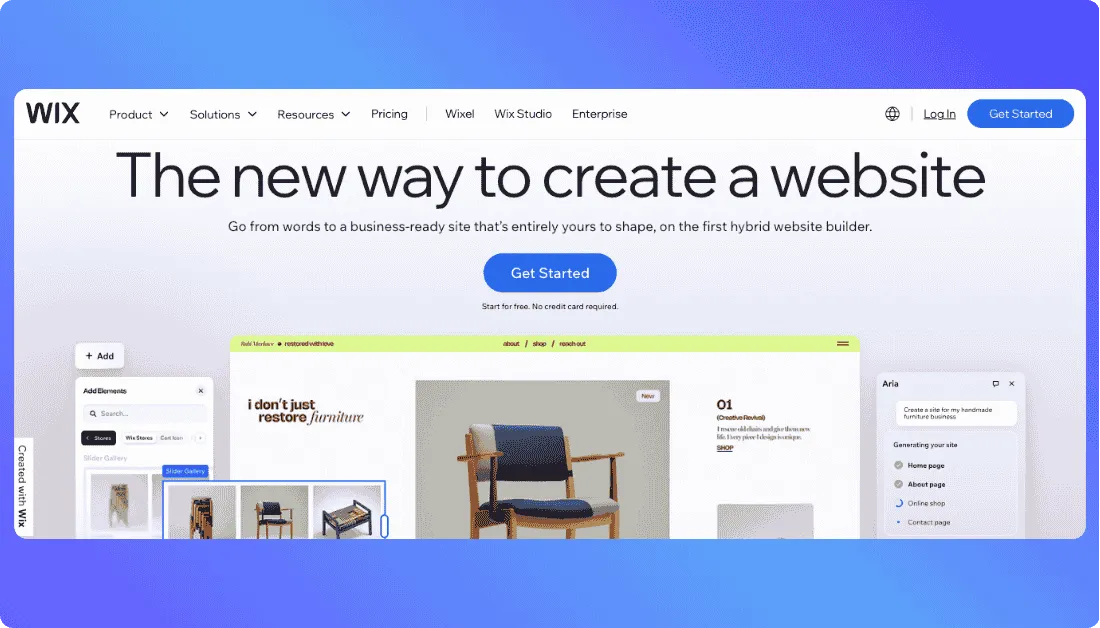
You can create an online menu, accept reservations 24/7, take payments, and manage online orders from the Wix dashboard.
Its online ordering system goes further with delivery, pickup, curbside pickup, dine-in ordering, future orders, coupons, loyalty programs, tips, and multi-location management.
That makes Wix one of the more practical choices for a restaurant that wants to get standard functionality running without designing each workflow individually.
The AI side is useful too.
Wix includes AI creation tools across its plans, while its restaurant templates can be customized with your own photos, copy, colors, fonts, pages, and layouts.
So you get a combination of AI-assisted generation and conventional visual editing.
That can be easier for a restaurant owner who wants direct control over how the site looks without working with code.
The tradeoff is flexibility.
Wix gives you plenty of restaurant functionality, but you are primarily building inside the Wix ecosystem.
If you eventually need highly unusual backend logic or functionality beyond its existing apps and integrations, a more open full-stack builder may offer more room.
We cover that broader decision in our guide
to Wix alternatives and in our comparison of Webflow alternatives for businesses that want different levels of design and development control.
Key Restaurant Website Features
- Customizable restaurant templates
- Online menus with images, descriptions, and categories
- 24/7 table reservations
- Online ordering and payment processing
- Pickup and delivery options
- Multi-location restaurant management
- Coupons and loyalty programs
- Mobile-ready restaurant pages
- Built-in SEO and analytics tools
Pricing
Wix has a free plan for building and testing a site.
Current annual-plan pricing starts at $17/month for Light, while Core starts at $29/month and adds payments and basic eCommerce features. Business starts at $39/month, with higher tiers available for more advanced requirements. Prices can vary by location.
For a restaurant that needs online payments or commerce features, Core or a higher plan is the more relevant comparison.
Best fit: Restaurants that want menus, reservations, online ordering, payments, and other day-to-day restaurant tools already packaged into one platform.
Best AI Restaurant Website Builders for Local Visibility + Growth
The next two builders focus less on custom backend development and more on helping restaurants get discovered and turn visitors into customers.
3. Zarla — Best for Fast Website Generation + Local SEO
Zarla is built around speed.
Describe your restaurant, location, and style, and its AI generates the copy, design, images, and SEO for a complete website.
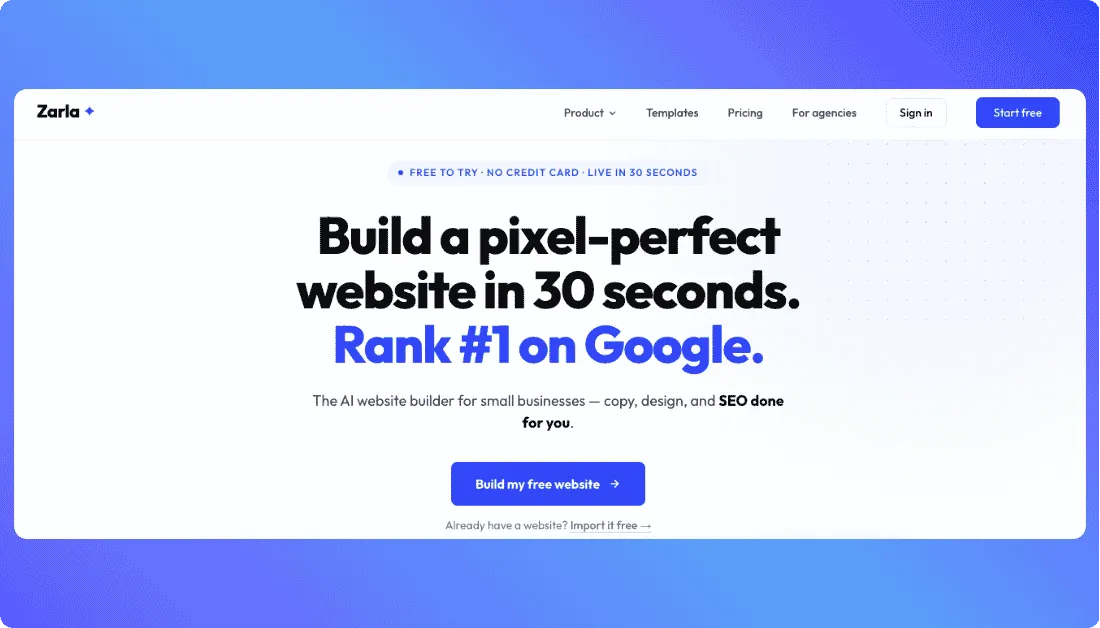
Zarla says a restaurant website can be generated in about 30 seconds, with menus, mobile-ready pages, and SEO included from the start.
What stands out is the local-search focus.
Zarla automatically handles titles, meta descriptions, schema markup, and mobile optimization. It also includes lead tracking, forms, Google-focused SEO tools, and chat-based editing.
So when your opening hours change or you launch a seasonal menu, you can simply ask the AI to update the page.
That is easier than digging through a traditional drag-and-drop editor.
The tradeoff is design control.
Zarla itself acknowledges that its AI-first approach sacrifices some pixel-by-pixel customization in exchange for speed.
If visual control matters more to you,
our guide to Squarespace alternatives covers platforms with different approaches to design flexibility.
Key Restaurant Website Features:
- AI-generated copy, design, images, and SEO
- Digital menus with prices and categories
- Local SEO and schema markup
- Chat-based website editing
- Mobile-responsive pages
- Built-in lead CRM and forms
- Online booking support
Pricing:
- Free to build and preview
- Premium: $10.99/mo on the 36-month plan
- Business: $16.99/mo on the 36-month plan
Best fit: Restaurants that want a professional website online quickly and place local SEO above detailed design customization.
4. Owner.com — Best for Restaurants Focused on Direct Online Orders
Owner.com treats the restaurant website as a sales channel, not just an online brochure.
Its platform combines an AI-optimized website with direct online ordering, automated SEO pages, catering, loyalty rewards, marketing, and a branded mobile app.
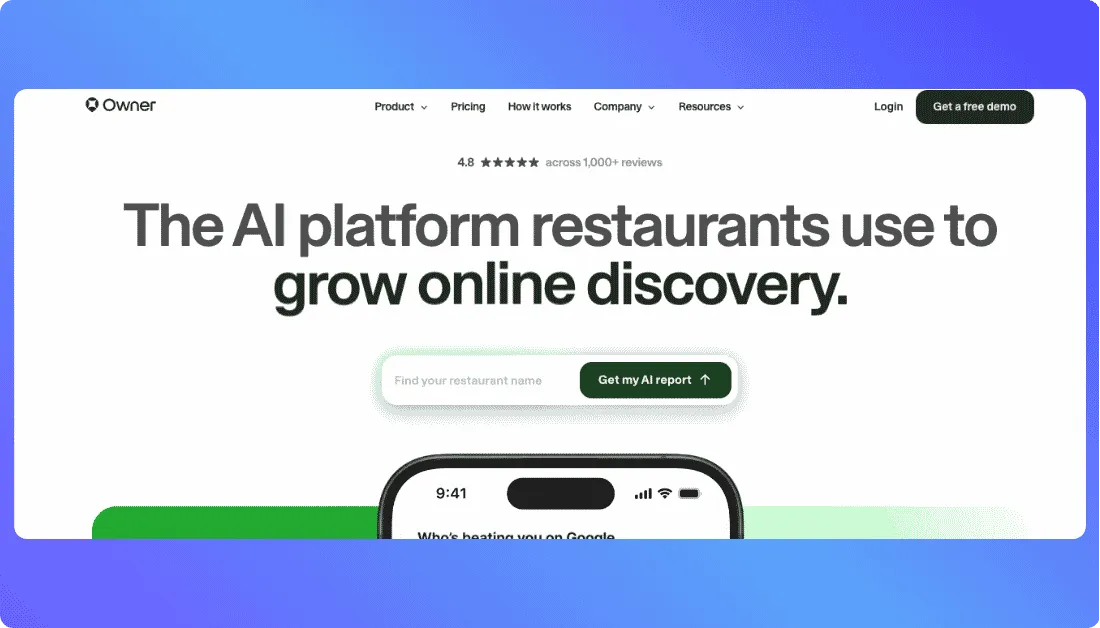
That makes it particularly relevant for takeout-heavy restaurants trying to drive customers toward direct orders instead of relying entirely on third-party marketplaces.
Owner also takes a more managed approach.
The company says many restaurants can get their new online presence set up within roughly a week, depending on how quickly business and domain information is supplied.
But there is a clear tradeoff.
Owner explicitly says restaurants looking for extensive design freedom may not be the right fit, because its websites prioritize sales performance over unlimited customization.
That is quite different
from a custom travel website builder or other full-stack platform where you can create more specialized workflows.
Key Restaurant Website Features:
- AI-optimized restaurant website
- Built-in online ordering
- Automated SEO pages
- Direct catering orders
- Loyalty and rewards
- Branded mobile app
- Email and SMS marketing
Pricing:
- Flexible: $249/mo + 5% restaurant fee per order
- Flat Rate: $499/mo with no additional restaurant fee
- Both plans are month-to-month
Best fit: Restaurants where direct ordering, repeat customers, and marketing matter more than complete design freedom.
Best AI Website Builder for Research-Driven Restaurant Sites
5. Manus — Best for AI-Led Research + Custom Generation
Manus has a different starting point.
You describe your cuisine, location, and atmosphere, and its AI agent can research local competitors and industry trends before creating the website.
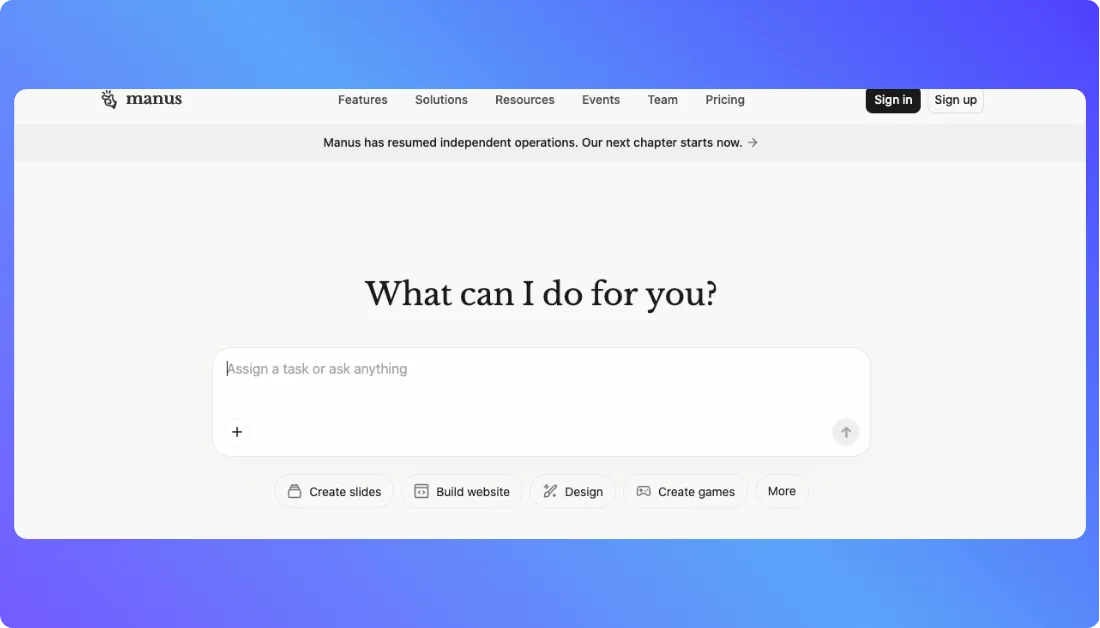
It then generates the layout and copy while setting up functionality such as online ordering and table reservations.
Manus can also create reservation forms, integrate booking widgets, build digital menus, and set up shopping carts and checkout flows.
You can continue changing the website through conversation after the first version is generated.
That workflow is useful for restaurant owners who want AI to handle more of the initial research instead of starting from a generic template.
It is similar to how AI can handle scheduling and booking-heavy experiences in a fitness website builder or the platforms covered in our guide to AI website builders for fitness businesses.
For more advanced prompt-led development,
see our guides to AI tools for freelancers building web apps and top AI coding tools.
Key Restaurant Website Features:
- AI-powered market and competitor research
- Generated layouts and website copy
- Digital menus
- Reservation forms and booking integrations
- Online ordering and checkout
- Responsive design
- Conversational editing
Pricing:
Manus lets users start building without a credit card. Its restaurant-builder page does not publish a fixed restaurant-specific price, so check the current plan and credit requirements before estimating your final cost.
Best fit: Restaurants that want AI to research their market and generate a tailored starting point rather than simply filling a predefined restaurant template.
Which AI Website Builder Fits Your Restaurant?
| Priority | Tool |
|---|---|
| Custom workflows | Vitara.ai |
| Restaurant tools | Wix |
| Local SEO | Zarla |
| Direct ordering | Owner.com |
| AI-led research | Manus |
What to Check Before You Commit
- Menu updates: Staff should change dishes, prices, and hours quickly.
- Ordering: Check whether checkout is native, integrated, or linked elsewhere.
- Mobile: Test menus, booking, directions, and ordering.
- Total cost: Include reservations, payments, and add-ons.
Go beyond static pages with custom workflows for menus, bookings, catering, customer accounts, and online ordering.
Try Vitara.ai Free →
Final Takeaway
The right builder depends on your restaurant.
Vitara.ai is worth considering when you need custom workflows, integrations and more control than a fixed template provides.
For more examples,
explore Vitara’s real estate website builder, our real estate website builders comparison, AI website builders for automotive sites, and two-hour real estate website workflow.
Frequently Asked Questions
What is the best AI website builder for restaurants?
The best option depends on what your restaurant needs. Vitara.ai suits custom workflows and integrations, while Wix focuses on ready-made restaurant features, Zarla on fast creation and local SEO, Owner.com on direct ordering, and Manus on AI-led research.
Can AI build a complete restaurant website?
Yes. Modern AI website builders can generate the layout, website copy, menu pages, contact sections, mobile design, forms, and basic SEO.
More advanced platforms can also help you create or connect reservation systems, online ordering, customer accounts, APIs, and custom restaurant workflows.
What should I ask an AI website builder to create for my restaurant?
Start with a detailed prompt describing your restaurant, cuisine, location, style, and the actions customers should be able to take.
Ask the AI to include:
- Food and drink menus
- Opening hours and location
- Online ordering
- Table reservations
- Photo gallery
- Contact information
- Google Maps
- Mobile-friendly navigation
- Local SEO pages
The more specific your prompt is, the less editing you will usually need afterward.
Can I build a restaurant website with online ordering using AI?
Yes, but online ordering works differently across builders.
Some restaurant website builders provide ordering natively. Others connect to third-party ordering platforms, while full-stack AI builders can create more customized ordering experiences or integrations.
Before choosing a platform, check whether customers can actually complete an order on your website or are simply redirected somewhere else.
Which AI restaurant website builder is best for reservations?
Wix is worth considering if you want restaurant reservations available as part of a broader ready-made restaurant ecosystem.
Vitara.ai makes more sense when the booking process needs custom logic, forms, integrations, or workflows that do not fit a standard reservation system.
Manus can also generate reservation flows and integrate booking functionality as part of an AI-generated restaurant site.
Can ChatGPT build a restaurant website for me?
ChatGPT can help you plan the website, write prompts, create menu copy, structure pages, generate code, and improve SEO content.
But you still need somewhere to build, host, and publish the website.
That is where an AI website builder becomes useful: you can take the idea you describe conversationally and turn it into a working website without manually assembling every page.
What pages should a restaurant website have?
Most restaurants do not need dozens of pages.
A strong starting structure is:
- Home
- Menu
- About
- Reservations
- Order Online
- Gallery
- Contact / Location
Restaurants offering catering, private dining, events, gift cards, or multiple locations may need additional pages.
Do I need coding skills to use an AI restaurant website builder?
No. Most AI website builders for restaurants are designed so you can start from a written prompt instead of coding the site yourself.
You may only need technical knowledge if you want unusually complex integrations, custom APIs, or complete control over the underlying code.
Platforms such as Vitara.ai can be useful here because you can start conversationally and still move into deeper customization when required.
Is an AI website builder better than hiring a web developer for a restaurant?
An AI builder can make more sense when you need to launch quickly, control costs, and make frequent menu or content updates yourself.
A developer may still be valuable when the project requires highly specialized branding, complex integrations, unusual performance requirements, or ongoing custom development.
For many independent restaurants, the practical middle ground is an AI builder that provides easy generation without preventing deeper customization later.
How much does an AI restaurant website cost?
The website builder subscription is only part of the cost.
Also check for:
- Domain fees
- Online ordering fees
- Payment-processing charges
- Reservation software
- Premium apps
- Email or SMS marketing
- Additional staff accounts
- Developer work
A cheaper monthly plan can become more expensive if essential restaurant features require several paid add-ons.
Can AI optimize my restaurant website for local SEO?
Yes. AI can help generate location-focused copy, page titles, meta descriptions, structured content, FAQs, and other SEO elements.
But local SEO still depends on accurate business information, useful restaurant content, mobile performance, consistent location details, and a well-maintained Google Business Profile.
AI can speed up the work. It does not replace the fundamentals.
Can an AI website builder create a digital restaurant menu?
Yes. You can use AI to organize dishes into categories, write descriptions, structure pricing, and create a mobile-friendly menu page.
The important part is editability.
Choose a platform where changing a price, removing a sold-out item, or adding a seasonal dish does not require rebuilding the entire page.
What is the easiest way to create a restaurant website with AI?
Start with one detailed prompt containing your restaurant name, cuisine, location, brand style, menu requirements, reservation method, ordering needs, and desired pages.
Generate the first version, then review the site in this order:
Menu → mobile experience → reservations → ordering → location/hours → SEO → design.
That keeps you focused on the parts customers actually use instead of spending hours changing fonts before the website works properly.
What’s New?