Top 7 Zite Alternatives for AI App Building in 2026
I’m not going to waste your time explaining what Zite is. You already know. That’s why you are here.
You are here because Zite may not give you the control, flexibility, or full stack freedom you need while building serious apps.
The AI app builder works well for creating business apps, internal tools, dashboards, portals, and workflows. But once your idea gets bigger, you may start feeling the limits. Maybe you want cleaner code ownership. Maybe you need better customization. Maybe you want more freedom with deployment, mobile app development, or product scale.
Whatever the reason, you are not alone. These are the three concerns many users face while looking for Zite alternatives:
- Limited control over generated apps: Some users want more freedom to edit, customize, export, and manage code beyond a guided no code setup.
- Credit based usage can feel restrictive: Frequent builders may need more room to test prompts, rebuild screens, improve logic, and make changes without watching AI credits too closely.
- Not every app fits one builder: Zite is useful for business apps, but startups, agencies, developers, and product teams may need stronger options for full stack apps, MVPs, frontend design, backend logic, or mobile app development.
And when you are building something that may become a real product, these limits matter fast.

Describe your idea and let Vitara.ai generate app screens, workflows, backend logic, and ready to refine code faster.
So, I compared the top Zite alternatives. Here’s what’s actually worth switching to.
TL;DR — Which Zite Alternative Should You Pick?
If you are short on time, here’s a quick breakdown of the five strongest Zite alternatives, ranked by full stack app building, code control, ease of use, backend support, and best use case.
Vitara — Best overall. Best fit for building full stack web and mobile apps with natural language prompts, editable code, code ownership, and flexible deployment. The strongest choice if you want to move from idea to working app without losing control.
Emergent — Best for AI agent based app development. A good option if you want AI agents to plan, build, test, and deploy apps through a guided development flow.
Base44 — Best for no code app building. A simple choice for non technical users who want to describe an idea and turn it into a working business app quickly.
Lovable — Best for startup MVPs. A strong option for founders and product teams that want to build web apps, SaaS dashboards, and prototypes with real code.
v0 — Best for frontend and UI generation. Ideal for developers, designers, and teams that need clean interfaces, landing pages, React components, and fast UI output.
Softr — Best for internal tools and client portals. A practical choice for teams that want to build dashboards, CRMs, employee tools, customer portals, and workflow-based business apps without writing code.
Bubble — Best for complex no-code applications. A better fit when you need custom workflows, databases, user accounts, permissions, integrations, and detailed visual control while still building without traditional coding.
| Tool | App Building Focus | Starting Price | Best For | Code Control |
|---|---|---|---|---|
| Vitara | Full stack web and mobile apps | Free plan available | Full stack app development with more control | High |
| Emergent | AI agent based full stack apps | Free plan available | AI guided app planning, building, and deployment | Medium to high |
| Base44 | No code business apps | Free plan available | Simple prompt based app creation | Medium |
| Lovable | Full stack web apps and MVPs | Free plan available | Startup MVPs, SaaS apps, and web app prototypes | High |
| v0 | Frontend, UI, and web interfaces | Free plan available | Landing pages, React components, and product UI | High for frontend |
| Softr | No code business apps, portals, and internal tools | Free plan available | Client portals, dashboards, CRMs, and internal business tools | Low to medium |
| Bubble | Complex no code web and mobile apps | Free plan available | Custom workflows, SaaS apps, marketplaces, and complex no code products | Medium |
Top 5 Zite Alternatives Compared
Let’s learn about each tool in detail.
1. Vitara
Vitara is the best Zite alternative if you want to build full stack web and mobile apps with more control over how your product works.
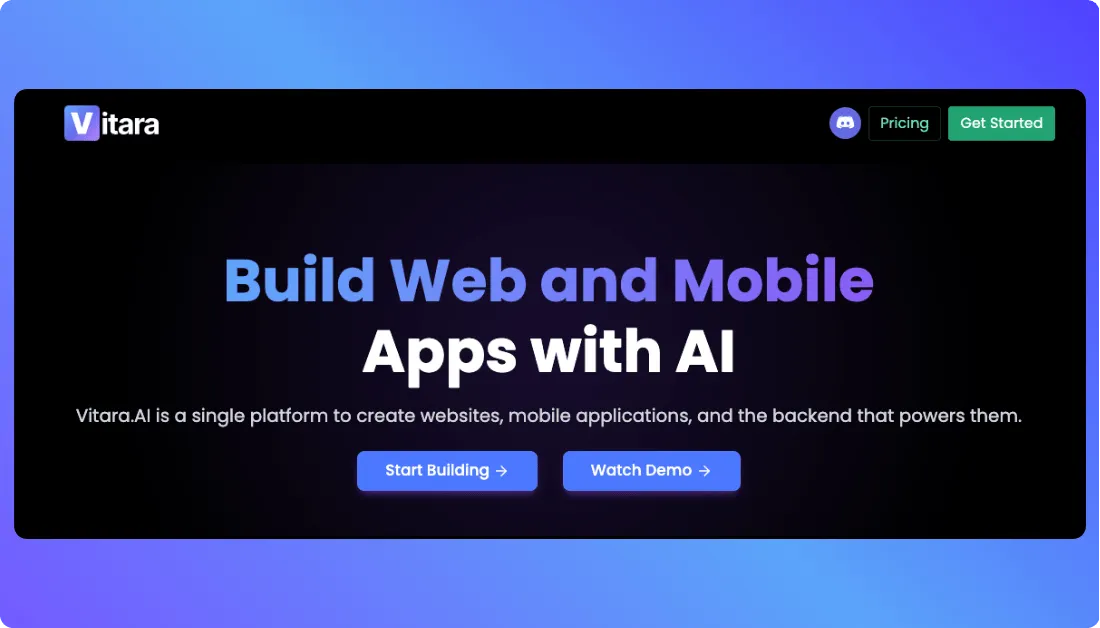
Zite is useful for creating business apps, workflows, dashboards, and internal tools. But Vitara goes a step further for users who want to build real software products from natural language prompts.
You describe what you want to build. Vitara helps turn that idea into a working app with frontend, backend, database logic, and editable code. That makes it useful for founders, startups, agencies, developers, and product teams that do not want to start from a blank screen.
Here’s where the difference becomes clear.
Zite works well when you want a guided AI app builder for business use cases. Vitara works better when you want more freedom to create, edit, customize, and scale your app like a real product.
You can use Vitara to build apps like SaaS platforms, client portals, dashboards, marketplaces, booking apps, internal tools, AI powered apps, mobile app ideas, and custom business software.
That makes it more than a simple no code app builder. It feels closer to a vibe coding platform built for people who want speed without giving up control.
Why Consider Vitara Over Zite?
- Full stack app building: Vitara helps you build frontend, backend, and app logic from one place.
- Better code control: You get more freedom to edit, manage, and customize the generated app.
- Web and mobile app support: Vitara is a better fit when your idea goes beyond a basic internal tool or dashboard.
- Faster MVP development: Founders can move from idea to working product without waiting weeks for the first version.
- Natural language prompts: You can describe screens, features, workflows, and app logic in simple words.
- More product focused: Vitara works well for SaaS apps, startup MVPs, business platforms, and custom software ideas.
- Useful for agencies: Agencies can use Vitara to speed up client app development and reduce repetitive setup work.
- Flexible development flow: You can start simple, improve the app step by step, and keep shaping the product as requirements change.
Bottom line: Vitara gives you a stronger path from idea to full stack app, especially when you want more control than a standard AI app builder can offer.
⭐ Best For:
Vitara is best for founders, startups, agencies, product teams, developers, and businesses that want to build full stack web and mobile apps faster with natural language prompts.
Key Features
- Natural language app generation
- Full stack web app development
- Mobile app development support
- Editable code output
- Frontend and backend generation
- Database and app logic support
- Fast MVP creation
- Browser based app building
- Code ownership and customization
- Flexible deployment options
- Useful for SaaS apps, dashboards, portals, and custom business software
Pros
- Best overall Zite alternative for full stack app development
- Gives more control over generated code and customization
- Works well for both technical and non technical users
- Helps founders build MVPs faster
- Useful for agencies handling multiple client projects
- Supports web and mobile app ideas
- Good fit for product focused teams
- Reduces the need to start development from scratch
Cons
- Complex apps may still need developer review
- Prompt quality matters, so vague instructions may lead to weak output
- Advanced custom features may take extra refinement
- Heavy usage may require a paid plan as the product grows
Pricing
- Free: $0/month includes starter access for testing AI app generation features
- Build: $20/month includes more generation capacity and faster app building workflows
- Scale: $100/month includes higher usage limits for startups, agencies, and growing product teams
- Enterprise: Custom pricing for larger businesses, advanced workflows, and dedicated support
2. Emergent
Emergent is a strong Zite alternative for users who want an AI agent to help build the app from start to finish.
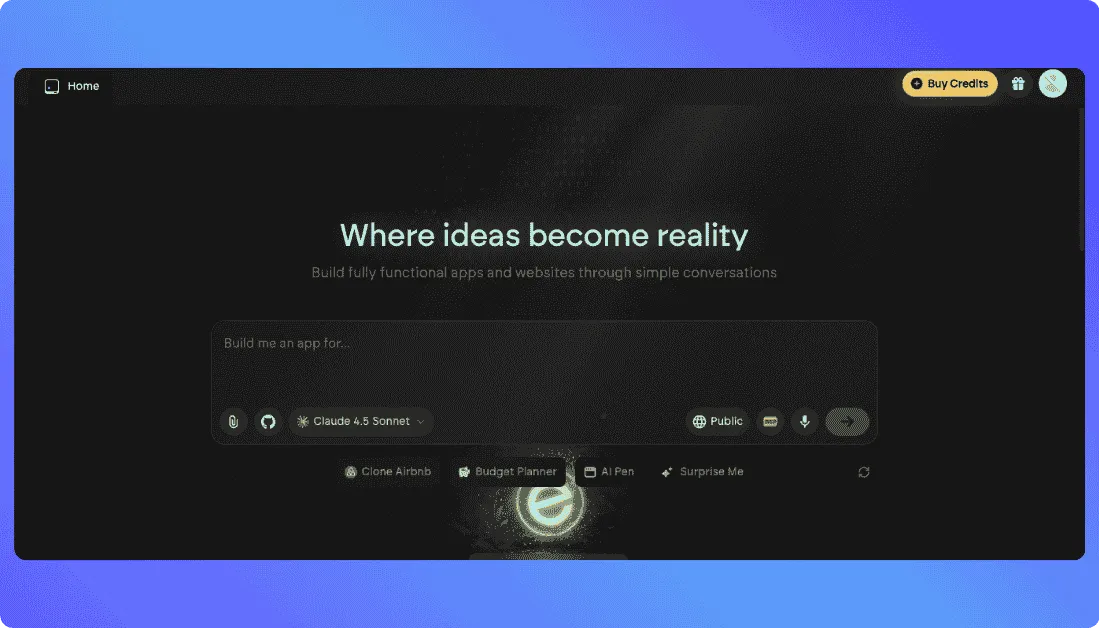
If Zite feels more like an AI powered business app builder, Emergent feels more like an agent driven vibe coding platform. You explain the app idea, and its AI agents help design, code, test, and deploy the application through conversation.
That makes Emergent useful when you don’t just want to create screens or workflows. You want the platform to think through the app structure, generate the frontend, support backend logic, connect databases, and move the product closer to launch.
It supports web and mobile app building, private project hosting, GitHub integration on paid plans, and custom AI agents on the Pro plan. The official site also describes Emergent as a platform for building production ready apps through conversation.
Why Consider Emergent Over Zite?
- Agent based development: Emergent uses AI agents that help design, code, and deploy your app from one place.
- Better for guided app creation: It works well when you want the AI to take more responsibility for planning and building the product.
- Full stack app support: Emergent can help with frontend, backend, databases, integrations, and hosting instead of only focusing on app screens.
- Web and mobile app building: The platform supports both web and mobile app experiences, which makes it useful for startup and product ideas.
- GitHub integration: Paid plans include GitHub integration, which helps users keep development closer to real software workflows.
⭐ Best For:
Emergent is best for founders, product builders, SMB owners, agencies, and teams that want an AI agent based app builder for web and mobile app development.
Key Features
- AI agent based app development
- Build production ready apps through conversation
- Web and mobile app building
- Frontend, backend, database, and integration support
- Private project hosting on paid plans
- GitHub integration on Standard and Pro plans
- Fork tasks for faster iteration
- 1M context window on Pro plan
- Ultra thinking on Pro plan
Pros
- Strong fit for AI agent based app development
- Helps users move from prompt to app through a guided flow
- Supports web and mobile app building
- Good option for founders and product teams building MVPs
- GitHub integration makes it more developer friendly
Cons
- Credit limits may feel tight for active builders
- Free plan is useful for testing, but not enough for serious app development
- Pro plan is much more expensive than Standard
- Complex apps may still need manual testing and developer review
Also Read:
Want to compare Zite with other tools before deciding?
Best Emergent Alternatives
Pricing
- Free: $0/month includes 10 free monthly credits and access to core platform features
- Standard: $20/month annual billing includes 100 credits/month
- Pro: $200/month annual billing includes 750 credits/month
- Enterprise: Custom pricing for larger teams, advanced needs, and business workflows
3. Base44
Base44 is built for speed and simplicity. If you want to describe an app idea in plain English and get a working business app quickly, it does the job well.
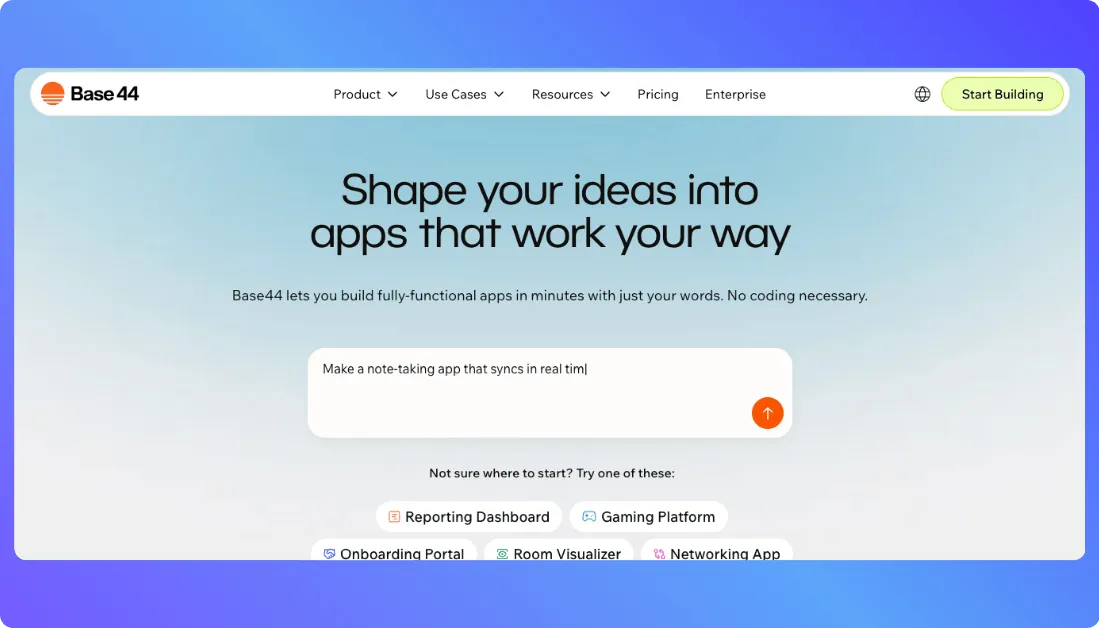
It is a good Zite alternative for users who want a simple AI app builder without dealing with too many technical steps. You can use it to build productivity apps, back office tools, customer portals, internal systems, and enterprise style products with natural language prompts.
Base44 also includes useful app building basics like authentication, database functionality, analytics, backend functions, cloud storage, payments, email tools, and integrations. That makes it helpful for non technical founders, small teams, and business users who want to launch functional apps without starting from code.
Why Consider Base44 Over Zite?
- Simple prompt based building: Base44 makes app creation feel easy for users who want to type what they need and get a working app.
- Useful for business apps: It fits productivity apps, internal tools, client portals, back office workflows, and simple enterprise products.
- Built in backend and database: Base44 includes backend and database support, so users do not need to connect too many external tools.
- Authentication included: Apps can include login, user management, and access related workflows.
- In app code edits: Paid plans support in app code edits, which gives more control than a pure no code setup.
- GitHub integration: Builder, Pro, and Elite plans include GitHub integration, which helps users manage projects with a more developer friendly workflow.
⭐ Best For:
Base44 is best for non technical founders, small teams, business users, and operators who want to build simple apps, portals, internal tools, and workflow based products with natural language prompts.
Key Features
- Responsive visual editor
- Analytics dashboard
- Cloud storage
- Payment processing
- Email marketing tools
- Debugging and troubleshooting tools
- Backend functions on paid plans
- GitHub integration on Builder, Pro, and Elite plans
Pros
- Very easy to use for non technical users
- Good fit for internal tools and business apps
- Includes backend, database, authentication, and analytics
- Free plan available for testing the platform
- Paid plans support unlimited apps
- In app code edits are available on paid plans
Cons
- Not ideal for users who want full architecture control
- Heavy builders may need higher plans quickly
- Less suitable for advanced mobile app or highly custom product development
Also Read:
Looking for tools similar to Zite? Start here:
Best Base44 Alternatives
Pricing
- Free: $0/month includes 25 message credits/month and 100 integration credits/month
- Starter: $16/month annual billing includes 100 message credits/month and 2,000 integration credits/month
- Builder: $40/month annual billing includes 250 message credits/month and 10,000 integration credits/month
- Pro: $80/month annual billing includes 500 message credits/month and 20,000 integration credits/month
- Elite: $160/month annual billing includes 1,200 message credits/month and 50,000 integration credits/month
4. Lovable
Lovable stands out for one clear reason. It helps users build real web apps from natural language prompts while still keeping the output close to actual software development.
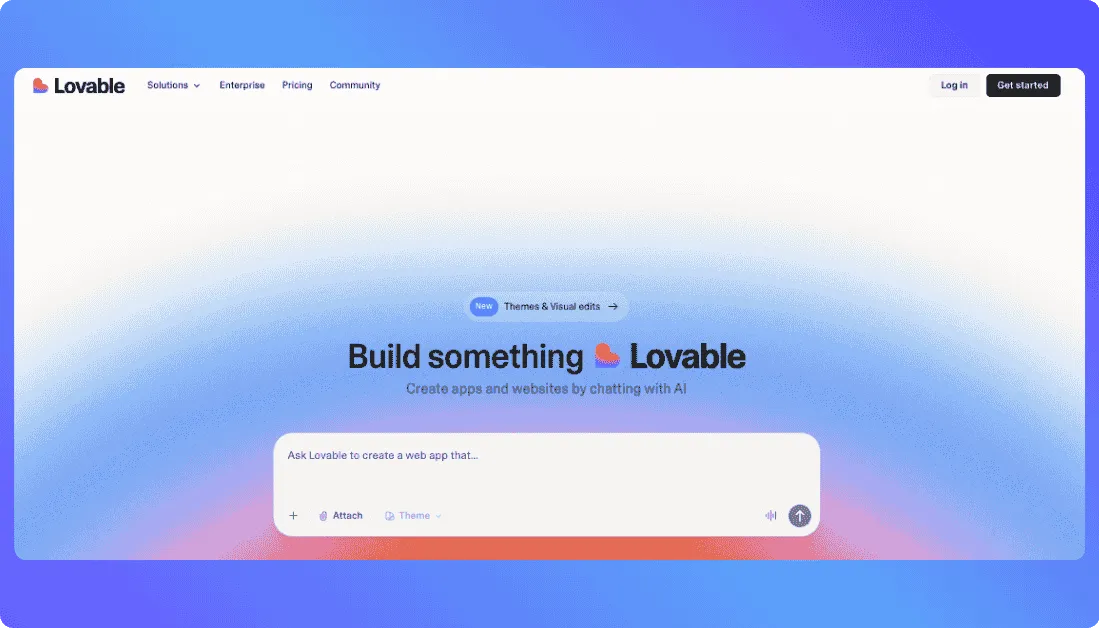
If your goal is to build a startup MVP, SaaS dashboard, customer portal, internal tool, marketplace, or web app prototype, Lovable is a strong Zite alternative.
Zite works well for business apps, workflows, and internal tools. Lovable feels more useful when you want to build and iterate on a product that may later need real code, integrations, authentication, database support, and deployment control.
Why Consider Lovable Over Zite?
- Real web app development: Lovable is a better fit when you want to build web apps and MVPs that feel closer to production software.
- Stronger MVP workflow: It works well for startup ideas, SaaS tools, dashboards, client portals, and product prototypes.
- Code ownership: Lovable’s FAQ includes project and code ownership guidance, which matters when you are building something serious.
- Team friendly pricing: Pro and Business plans are shared across unlimited users, which can help small teams collaborate without paying per seat.
⭐ Best For:
Lovable is best for founders, makers, product teams, developers, and startup teams that want to build MVPs, SaaS apps, web app prototypes, and internal tools faster.
Key Features
- Natural language web app generation
- Full stack web app development
- Prompt based app iteration
- Custom domains on Pro plan
- Unlimited lovable.app domains on Pro plan
- Credit rollovers on Pro plan
Pros
- Strong option for startup MVPs and web apps
- Good balance between speed and code control
- Useful for founders and technical teams
- Pro and Business plans support unlimited users
- Custom domains and badge removal available on Pro
Cons
- Mainly focused on web apps, not mobile app development
- Free plan details may feel limited for serious product building
- Complex apps still need testing and developer review
- Business plan can become costly for solo users
- Not ideal for users who only need simple no code internal tools
Also Read:
Not sure Zite is right for your team? Check these alternatives:
Top Lovable Alternatives
Pricing
- Free: $0/month includes limited daily credits for testing and basic app generation.
- Pro: $25/month annual billing includes 100 monthly credits, custom domains, badge removal, credit rollovers, and unlimited lovable.app domains.
- Business: $50/month annual billing includes SSO, team workspace, role based access, security center, and everything in Pro.
- Enterprise: Custom pricing includes audit logs, custom connectors, onboarding support, advanced governance controls, and enterprise level collaboration features.
5. v0
v0’s biggest strength is frontend speed.
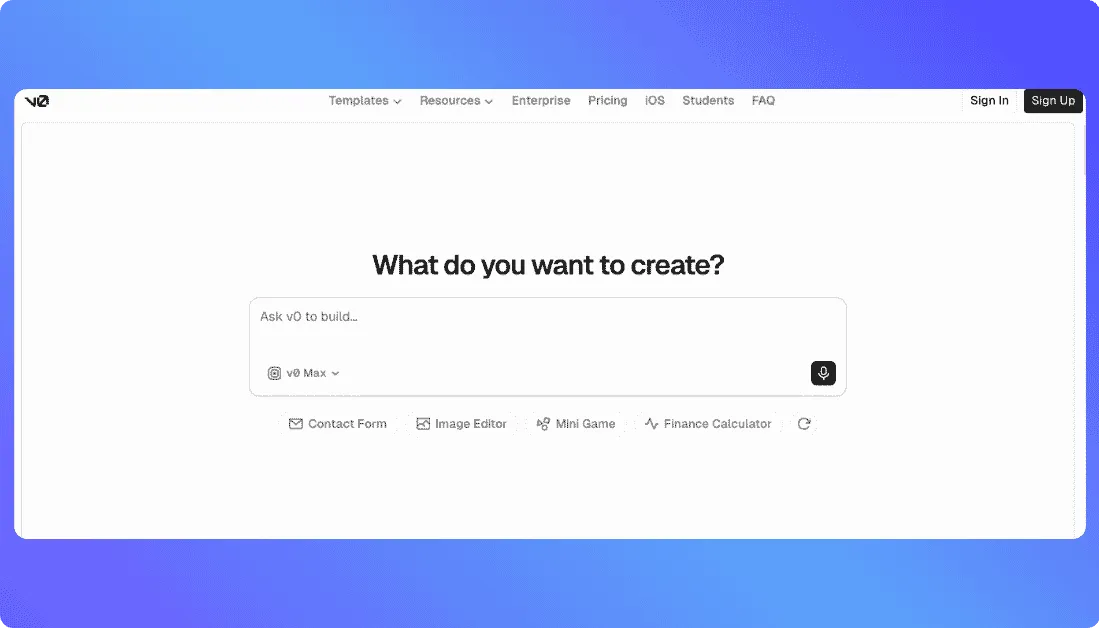
If you want to generate clean UI, landing pages, dashboards, React components, and app interfaces from a prompt, v0 is one of the strongest Zite alternatives. It is especially useful when the app’s look, layout, and user experience matter from day one.
Zite works well for business apps and workflows. v0 works better when you want polished frontend output and a faster way to design product screens before connecting deeper backend logic.
You can use v0 to build SaaS pages, admin dashboards, login screens, pricing sections, forms, product cards, and full web app interfaces. It also supports visual editing, GitHub sync, and Vercel deployment, which makes it a strong fit for developers and design focused teams.
Why Consider v0 Over Zite?
- Stronger UI generation: v0 is better when you need polished interfaces, responsive layouts, and production style frontend components.
- Developer friendly workflow: It works well for teams using React, Next.js, GitHub, and Vercel.
- Visual editing: Users can edit designs visually with Design Mode, which helps speed up frontend changes.
- Vercel deployment: Free users can deploy apps to Vercel, which makes testing and sharing easier.
- GitHub sync: v0 supports GitHub sync, helping developers keep generated work connected to their code workflow.
⭐ Best For:
v0 is best for developers, designers, founders, and frontend teams that want to create polished app interfaces, landing pages, dashboards, and React based web experiences faster.
Key Features
- AI powered UI generation
- Frontend and React component generation
- Full stack app building support
- Visual editing with Design Mode
- GitHub sync
- Vercel app deployment
- Team collaboration on paid plans
Pros
- Excellent for frontend and UI generation
- Great fit for React, Next.js, and Vercel users
- GitHub sync makes it developer friendly
- Useful for landing pages, dashboards, forms, and product UI
Cons
- Not the best choice for non technical users who want a simple no code business app builder
- Backend and workflow use cases may need more developer involvement
- Free plan has a 7 message per day limit
- Team and Business plans are priced per user
Also Read:
Before you commit to Zite, explore other top options:
Top Vercel V0 Alternatives
Pricing
- Free: $0/month includes $5 monthly credits, Vercel deployment, Design Mode, GitHub sync, and 7 messages/day.
- Team: $30/user/month includes $30 monthly credits per user, shared team credits, centralized billing, and collaboration features.
- Business: $100/user/month includes training opt out by default, shared credits, centralized billing, and advanced collaboration controls.
- Enterprise: Custom pricing includes SAML SSO, role based access control, priority performance, support SLAs, and no training on your data.
6. Softr
Softr is a strong Zite alternative for teams that want to build internal tools, client portals, dashboards, CRMs, and other business apps without writing code.
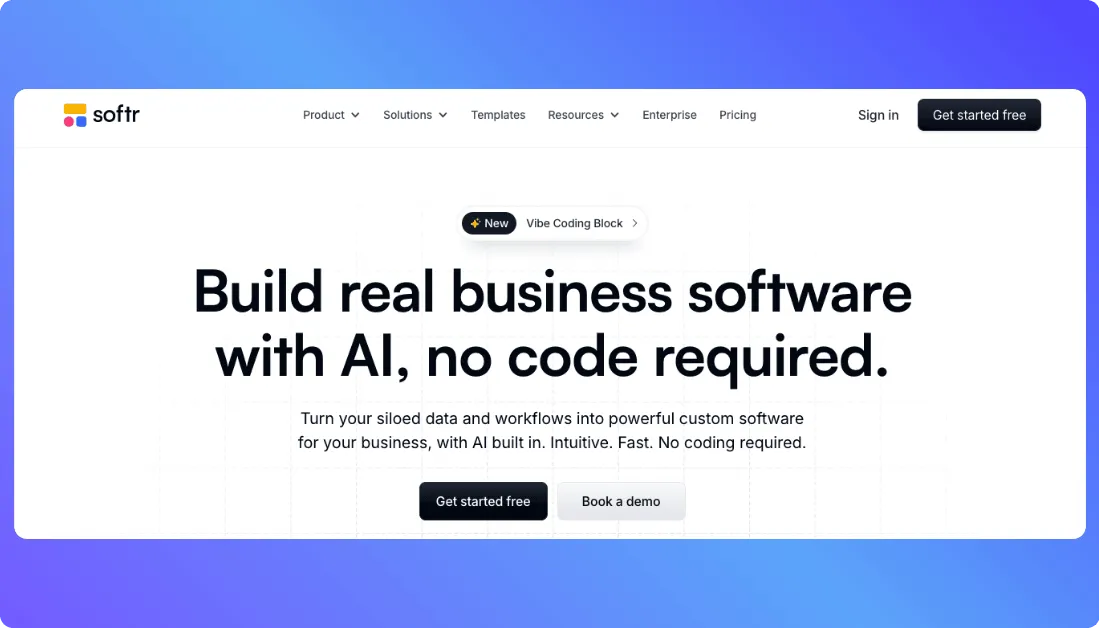
You can describe what you need, and Softr’s AI Co-Builder can generate the app interface, database, and business logic. From there, you can continue making changes with AI or edit the app visually. Softr also includes its own database and workflow tools, so you don’t always need separate services for storing data or automating business processes.
Where Softr becomes especially useful is existing business data. You can connect sources such as Airtable, Google Sheets, Notion, HubSpot, monday.com, Supabase, MySQL, PostgreSQL, and REST APIs, then turn that data into a secure portal or internal application.
Why Consider Softr Over Zite?
- Strong for internal tools and portals: Softr works particularly well for customer portals, employee tools, dashboards, CRMs, inventory systems, and other operational business apps.
- AI plus visual editing: You can start with a prompt and then refine the generated application visually instead of relying only on AI prompts.
- Built-in database: Softr includes its own database for storing and managing application data.
- Workflow automation: You can automate simple tasks and multi-step processes within the same platform.
- Flexible data connections: Softr connects with popular business tools and databases, making it useful when your company already has data spread across different systems.
- User roles and permissions: Softr lets teams control roles, permissions, and access to business data, which matters when building apps for employees, clients, or partners.
⭐ Best For:
Softr is best for operations teams, agencies, SMBs, and non-technical users that want to create internal tools, client portals, dashboards, CRMs, inventory apps, and workflow-based business software without managing traditional development.
Key Features
- AI Co-Builder for business apps
- Visual no-code app editing
- Built-in Softr Databases
- Workflow automation
- User roles and permissions
- Client and vendor portals
- Internal tools and dashboards
Pros
- Easy for non-technical business teams to learn
- Strong fit for portals, dashboards, and internal business tools
- Combines app building, databases, and workflows in one platform
- Lets you refine AI-generated apps visually
- Works with many existing business data sources
- Good permission controls for apps shared with employees or clients
- Free plan available for trying the platform
Cons
- Less suitable if your priority is owning and freely modifying a traditional source-code codebase
- Highly custom product experiences may require more work than standard business apps
- Usage, user, record, AI-credit, and workflow limits increase by pricing tier
- Teams building complex consumer-facing software may prefer a more developer-focused full-stack AI app builder
Want a deeper look at how Softr performs before choosing it?
Pricing
- Free: $0/month for exploring Softr and building a small app
- Basic: $19/month for individuals who need more capacity
- Pro: $99/month for small teams building operational tools
- Business: $329/month for larger teams with higher usage and business requirements
- Enterprise: Custom pricing for organizations that need enterprise-level security, governance, support, and scale
7. Bubble
Bubble is a strong Zite alternative if you want to build more complex web or mobile apps without writing traditional code.
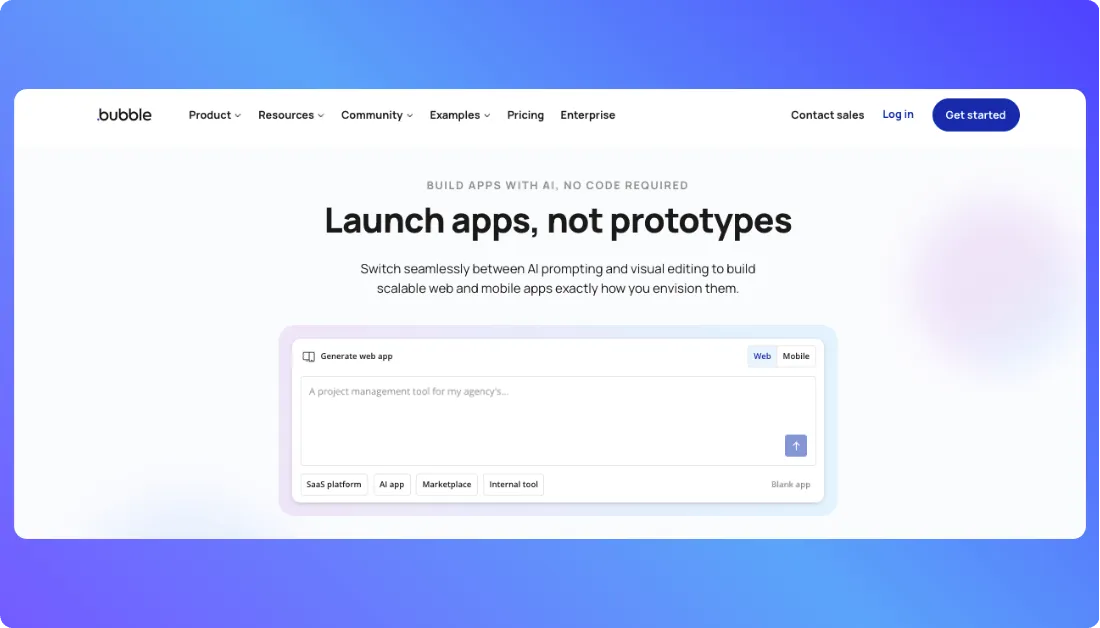
Bubble combines AI app generation with a visual no-code editor. You can describe your app idea in a prompt, generate the initial UI, database, and logic, and then continue refining everything visually. That gives you more hands-on control when your app needs custom workflows, user roles, payments, databases, or detailed business logic.
It also supports native iOS and Android app development. Web and mobile apps can share the same backend, database, workflows, and API connections, which makes Bubble useful for teams that want to manage multiple app experiences from one platform.
Why Consider Bubble Over Zite?
- More visual control: Bubble gives you a detailed visual editor for changing layouts, workflows, databases, privacy rules, and app behavior without working directly with code.
- AI plus no-code editing: You can start with Bubble AI and then switch to visual editing when you need more precise changes.
- Built-in database and backend: Bubble includes data storage, authentication, workflows, and backend logic, so you can build complete applications without connecting a separate backend for basic use cases.
- Complex workflow support: It works well for apps that need scheduled tasks, user actions, payment flows, data processing, and custom business rules.
- API support: Bubble offers Data API and Workflow API options for connecting your app with external systems and services.
- Native mobile development: Bubble can build and publish native iOS and Android apps alongside web apps. Its native mobile tooling is currently marked as beta.
⭐ Best For:
Bubble is best for founders, startups, agencies, and non-technical product builders who want to create SaaS products, marketplaces, customer portals, internal tools, workflow-heavy applications, and web or mobile apps without relying on traditional coding.
Key Features
- AI-powered app generation
- Visual drag-and-drop editor
- Built-in database
- Backend workflows
- User authentication
- Privacy rules and permissions
- Responsive web apps
- Native iOS and Android app development
- Workflow API
- Data API
- API Connector
Pros
- Strong choice for complex no-code app development
- Gives more visual control than prompt-only AI builders
- Handles frontend, database, and workflows in one platform
- Useful for SaaS products, marketplaces, portals, and internal tools
- Supports web and native mobile apps
Cons
- Bubble has a steeper learning curve than simpler AI app builders
- You don’t get a traditional exportable source-code project
- Complex workflows can take time to design and debug
- Bubble uses workload-based pricing, so costs can increase as app activity grows
Looking for more tools similar to Bubble?
How I Tested These Zite Alternatives
I didn’t want to rank these Zite alternatives based only on feature pages or marketing claims. I compared each platform using the same practical criteria that matter when you’re building a real app.
- Prompt-to-app experience: I looked at how easily each AI app builder can turn a plain-English idea into a usable application without forcing you through unnecessary setup.
- Frontend quality: I compared how well each platform handles layouts, dashboards, forms, responsive screens, navigation, and overall UI customization.
- Backend capabilities: I checked whether the tool supports databases, authentication, business logic, APIs, workflows, and other backend requirements needed for full-stack app development.
- Code control and ownership: I considered how much freedom you get to edit, export, sync, or continue developing the generated code outside the platform.
- Customization: I looked at how easy it is to change screens, workflows, database structures, permissions, and app behavior once the first version is generated.
- Integrations: I compared support for APIs, GitHub, third-party services, external databases, payment tools, and other integrations you may need as your app grows.
- Web and mobile support: I checked whether each Zite competitor works mainly for web apps or can also support responsive, PWA, or mobile app development.
- Deployment options: I considered how easy it is to publish an app, connect a custom domain, manage hosting, or move the project into a developer-friendly deployment workflow.
- Ease of use: I looked at how comfortable each platform feels for founders, non-technical users, developers, agencies, and product teams with different skill levels.
- Pricing and usage limits: I compared free plans, paid plans, AI credits, user limits, and other restrictions that can affect the real cost once you start building regularly.
- Long-term flexibility: I considered whether the platform works only for quick prototypes or gives you enough control to keep improving, maintaining, and scaling the app as requirements become more complex.
Which Zite Alternative Should You Choose?
The right Zite alternative depends on what you want to build, how technical you are, and how much control you need over the final product. Here’s a simple way to narrow down your options.
- Choose Vitara if you want full-stack app development with more control. It’s a strong option for founders, startups, agencies, and product teams that want to build web or mobile apps with editable code, backend logic, databases, and flexible deployment.
- Choose Emergent if you prefer an AI agent-driven development process. It works well when you want AI to take a bigger role in planning, building, testing, and moving your application toward deployment.
- Choose Base44 if speed and simplicity matter most. It’s a good fit for non-technical founders and business users who want to describe an app, portal, dashboard, or workflow in plain English and get a working version quickly.
- Choose Lovable if you’re building a SaaS MVP or startup web app. It suits founders, makers, and developers who want fast prompt-based app development while keeping access to code and a developer-friendly GitHub workflow.
- Choose v0 if frontend design is your main priority. It’s better suited to developers and designers who want to generate polished React interfaces, dashboards, landing pages, forms, and product screens quickly.
- Choose Softr if you need internal tools, dashboards, or client portals. Its no-code approach works well for business apps, employee tools, CRM-style systems, customer portals, and workflows where ease of use matters more than deep code control.
- Choose Bubble if you want to build a more complex no-code application. Bubble makes sense when you need custom workflows, databases, user accounts, permissions, integrations, and detailed visual control without building everything with traditional code.
Zite is useful for business apps, but Vitara.ai gives you a stronger path to build, customize, and scale full-stack software products.
Try Vitara.ai Today →
Final Verdict: Is It Worth Switching from Zite?
Zite is a useful AI app builder. It helps users create business apps, internal tools, dashboards, portals, and workflows without starting from scratch.
But if you want more control over code, stronger full stack flexibility, better mobile app support, or a faster path from idea to real product, then switching to a Zite alternative makes sense.
Every tool on this list solves one specific gap. Emergent is good for AI agent based app development. Base44 works well for simple no code business apps. Lovable is strong for startup MVPs. v0 is great for frontend and UI generation.
But if I had to pick one Zite alternative that gives the best balance of speed, control, and product building freedom, it’s Vitara.
Because Vitara helps you build full stack web and mobile apps with natural language prompts, editable code, code ownership, and flexible deployment. You don’t just create a basic app. You get a better path to build, improve, and scale a real software product.
The right alternative depends on what you’re building.
But the wrong move is staying with a tool that limits your product vision when better AI app builders are available today.
Before you decide, check out these related alternatives:
Top Launchpad.io Alternatives
Best Firebasestudio Alternatives
FAQs
What is the best Zite alternative?
Vitara is the best Zite alternative if you want to build full stack web and mobile apps with more control. It gives you natural language app generation, editable code, code ownership, and flexible deployment.
Why should I look for a Zite alternative?
You should look for a Zite alternative if you need better code control, stronger customization, mobile app support, or more flexibility while building full stack apps.
Is Vitara better than Zite?
Vitara is better than Zite for users who want to build real software products, not just business apps or internal tools. It works well for MVPs, SaaS apps, portals, dashboards, and custom app ideas.
Which Zite alternative is best for startup MVPs?
Lovable and Vitara are strong choices for startup MVPs. Lovable works well for web app prototypes, while Vitara is better when you need full stack web and mobile app development.
Which Zite alternative is best for no code users?
Base44 is a good Zite alternative for no code users. It helps non technical users build business apps, portals, and internal tools using simple prompts.
Which Zite alternative is best for UI generation?
v0 is the best Zite alternative for UI generation. It helps create landing pages, dashboards, React components, forms, and polished product interfaces quickly.
Is Emergent a good Zite alternative?
Yes. Emergent is a good Zite alternative if you want AI agents to help plan, build, test, and deploy your app through a guided development flow.
Can I build mobile apps with Zite alternatives?
Yes. Some Zite alternatives support mobile app building or mobile friendly app experiences. Vitara is a better choice if mobile app support is one of your main needs.
Which Zite alternative is best for developers?
Vitara, Lovable, and v0 are strong options for developers. Vitara is better for full stack app building, Lovable is good for MVPs, and v0 works best for frontend and UI focused work.
What should I check before choosing a Zite alternative?
Check code control, backend support, database options, mobile app support, pricing, deployment flexibility, and how well the tool fits your app type. A good Zite alternative should help you build faster without limiting your product later.
What’s New?