5 Best AI Website Builders for B2B Companies in 2026: Tested by Use Case
If your AI website builder can make a polished homepage but cannot handle demo requests, lead routing, client portals, or custom workflows, it may not be built for B2B.
That is where choosing the right platform gets tricky.
A B2B website has to do more than look good.
It may need to capture qualified leads, connect with your sales stack, publish SEO content, manage customer accounts, or even handle wholesale buying.
So I narrowed the market down to five AI website builders based on the B2B job they actually do best.
Here is the quick answer.
Quick Comparison: 5 Best AI Website Builders for B2B Companies
| Tool | Best For | B2B Standout | AI Approach |
|---|---|---|---|
| Vitara.ai — Recommended | Custom B2B sites, SaaS, portals | Full-stack frontend + backend | Prompt-based generation |
| Wix | Marketing and lead generation | Business ecosystem | Conversational AI + visual editor |
| Duda | Agencies and multi-site teams | White-label + client workflows | AI site generation |
| 10Web | WordPress B2B sites | WordPress ecosystem | AI WordPress generation |
| Shopify | B2B ecommerce and wholesale | Catalogs, buyer accounts, pricing rules | Commerce + AI assistance |
The biggest difference is what happens after the first AI-generated draft.
Some tools are strongest at marketing pages. Others make more sense when your website needs backend logic, WordPress control, agency workflows, or real B2B commerce.

Build custom B2B sites, portals, and workflows with AI prompts, React frontend, Node.js backend, and editable code.
Start Building with Vitara.ai →
How I Evaluated These AI Website Builders
A B2B website has a different job from a portfolio or personal blog.
So I did not compare these tools on AI generation speed alone.
I focused on what matters once real prospects start using the site:
- Lead capture: Demo forms, qualification flows, and conversion pages
- Integrations: APIs, automation, CRM connections, and business tools
- AI output quality: How usable the first generated version is
- Customization: How far you can move beyond the initial AI design
- SEO and content: Metadata, landing pages, blogs, and ongoing publishing
- Scalability: Portals, accounts, workflows, multiple sites, or larger catalogs
- Ownership: How much control you keep after launch
- Cost: Hosting, AI credits, apps, and add-ons as well as the base plan
If you are comparing newer vibe coding tools with traditional website builders, this distinction matters.
The best AI website builder for B2B is not always the one that generates a homepage fastest.
It is the one that still fits when the website becomes part of your actual business workflow.
Best AI Website Builders for B2B Lead Generation + Custom Workflows
If your website needs to go beyond pages and forms, start here.
1. Vitara.ai — Best Overall for Custom B2B Websites and Workflows
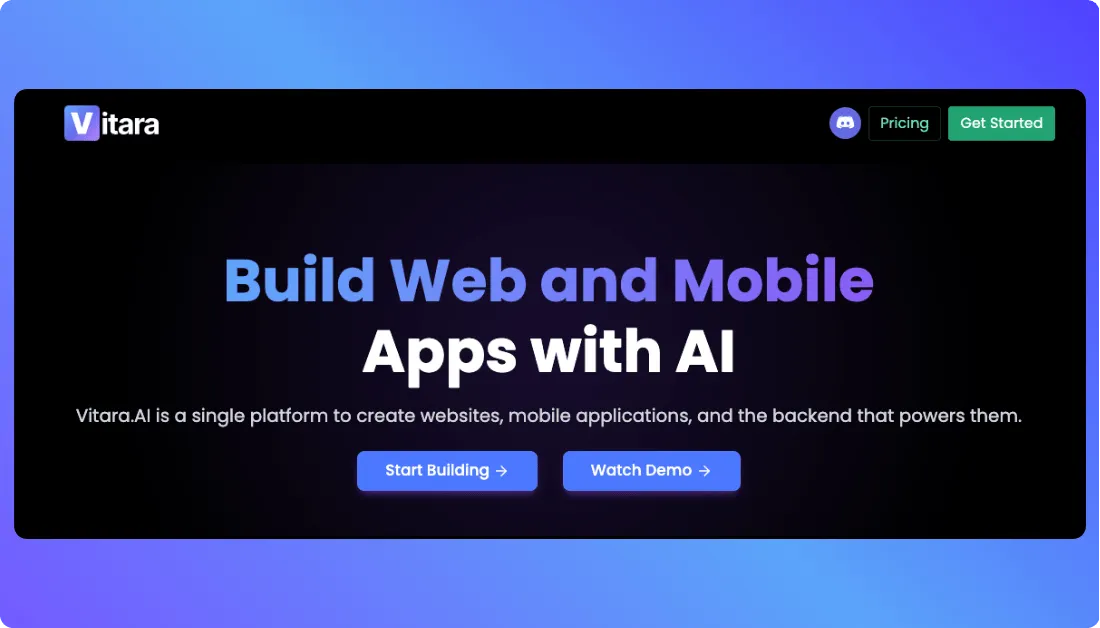
Vitara.ai is the strongest fit on this list when the website needs to do more than display content.
Instead of stopping at layouts and copy, Vitara can generate the frontend and backend of a working web application from natural-language prompts.
That matters for B2B companies building customer portals, client dashboards, gated tools, internal workflows, SaaS experiences, or lead-generation sites with custom logic.
You can work with a React frontend and Node.js backend while keeping editable source code.
That puts Vitara closer to a full-stack AI builder than a traditional template-based website builder.
For teams exploring enterprise vibe coding tools, that extra flexibility is the main reason to consider it.
Key B2B Website Features
- Prompt-to-website and web app generation
- React frontend and Node.js backend
- APIs and custom backend workflows
- Authentication and application-style experiences
- Editable and exportable source code
- GitHub-friendly development and deployment
Pricing
Vitara.ai has a free plan and two main paid plans:
- Starter: $0 — includes 5 daily credits plus 20 one-time credits for exploring the platform
- Build:$20/month — includes 100 monthly credits, faster AI processing, custom domain support, and the ability to edit and download your code
- Scale:$50/month — includes everything in Build plus 250 monthly credits for heavier usage
- Custom: Custom pricing is available for teams with larger usage requirements
For most B2B companies building a production website, SaaS MVP, customer portal, or custom workflow, Build is the practical starting point because code editing, code download, and custom domains are included at $20/month.
For more detail
see Vitara’s full-stack React and Node.js app builder.
Verdict: Best for B2B SaaS companies, startups, and teams that need a website plus custom workflows, portals, or backend functionality.
Create demo flows, client portals, dashboards, APIs, and backend logic with full-stack AI app generation.
Build with Vitara.ai →
2. Wix — Best for B2B Marketing and Lead Generation
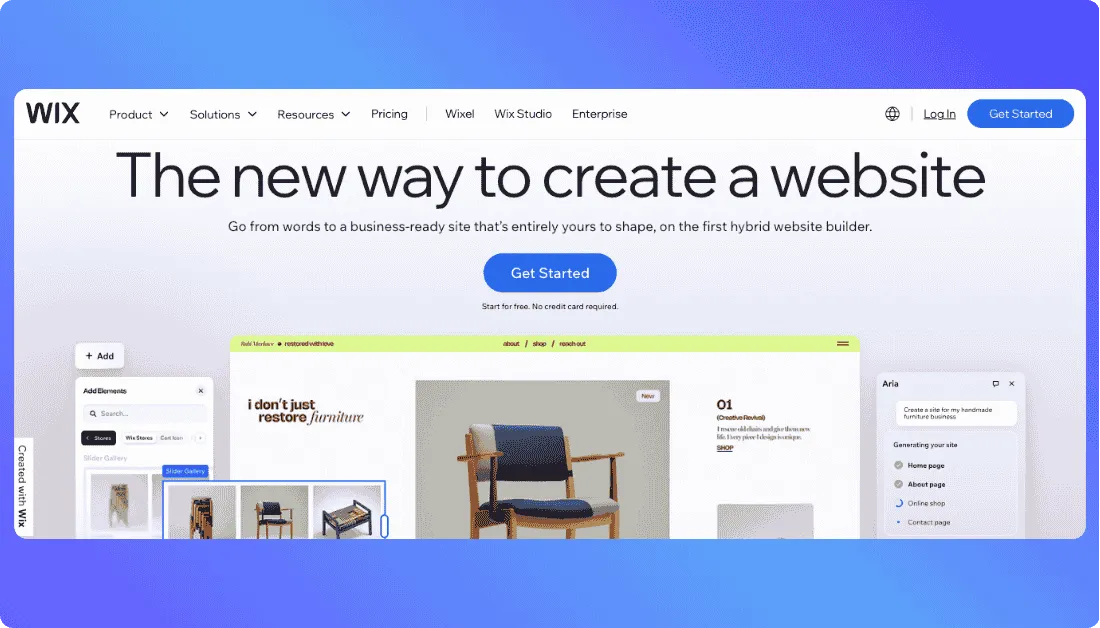
Wix makes more sense when your main goal is not building a custom application.
It is better suited to B2B companies that need a professional marketing website, landing pages, lead forms, a blog, and common business integrations without dealing with code.
Its AI website-building experience can generate the initial site structure, design, and content from a description of your business.
The useful part is what happens afterward.
You are not locked into the first AI-generated version.
Wix gives you a visual editor to change sections, layouts, copy, images, forms, and navigation as your website evolves.
That makes it practical for B2B service companies that regularly launch campaign pages or update messaging for different industries and buyer personas.
Lead generation is another strong point.
You can add contact forms, booking flows, email marketing features, CRM-style contact management, and integrations without stitching together a completely separate website stack.
Its blogging and SEO features also make Wix useful for B2B companies that rely on organic traffic and content marketing.
Key B2B Website Features
- AI-assisted multi-page website generation
- Visual drag-and-drop customization
- Lead forms and contact management
- Booking and scheduling tools
- Blogging and CMS capabilities
- SEO settings and marketing tools
- Large app and integration ecosystem
Pricing
Wix lets you start for free, while its paid website plans start at $17/month when billed annually.
- Free: $0/month
- Light:$17/month annually or $24 month-to-month
- Core:$29/month annually or $36 month-to-month
- Business:$39/month annually or $46 month-to-month
- Business Elite:$159/month annually or $172 month-to-month
- Enterprise: Custom pricing
AI website creation is available even on the free plan, while paid plans add benefits such as a custom domain, additional storage, business tools, payments, ecommerce, and more collaborators.
For a typical B2B lead-generation website, Core or Business will make more sense than Light if you need payments, stronger marketing features, more storage, or a larger team.
Verdict: Best for small-to-midsize B2B companies that want an AI-assisted marketing and lead-generation website without taking on a development project.
If Wix feels too restrictive for your requirements
our guide to Wix alternatives covers other options worth considering.
Best AI Website Builder for Agencies and Multi-Site B2B Teams
Building one B2B website is one thing.
Building and maintaining dozens of them for clients requires a different workflow.
3. Duda — Best for Agencies Managing B2B Client Websites
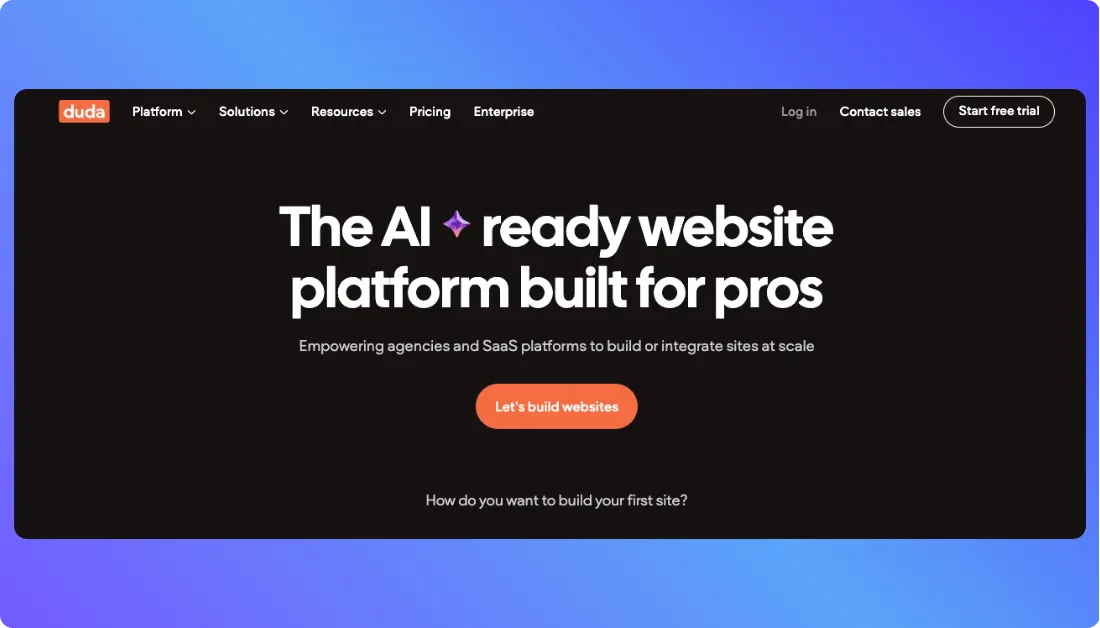
Duda stands out for agencies, web studios, and teams that need to build websites repeatedly rather than launch just one.
Its biggest advantage is not simply AI generation.
It is the infrastructure around client website management.
Agencies can create sites, collaborate with clients, control permissions, manage multiple projects, and hand websites over without building their own management system.
Duda’s AI tools can also help generate website sections, business copy, SEO metadata, and other content during the building process.
That can cut down the repetitive work involved in producing similar B2B service websites for different clients.
White-label capabilities are another reason agencies may prefer Duda over consumer-focused AI website builders.
Clients can interact with a more customized experience instead of feeling like they are being passed directly into a third-party website platform.
For teams comparing Duda with more design-focused platforms, our list of Webflow alternatives provides additional options.
For teams comparing Duda with more design-focused platform
our list of Webflow alternatives provides additional options.
Key B2B Agency Features
- AI-assisted website and content generation
- Multi-site management
- Client collaboration and permissions
- White-label capabilities
- SEO and metadata tools
- Custom widgets and reusable sections
- Agency-focused site management workflows
Pricing
Duda offers a 14-day free trial, followed by four public paid plans and a custom enterprise option:
- Basic:$25/month, or $19/month billed annually
- Team:$39/month, or $29/month billed annually
- Agency:$69/month, or $52/month billed annually
- White Label:$199/month, or $149/month billed annually
- Custom: Contact Duda for pricing
Basic and Team include one published website, while Agency and White Label include four.
Additional sites currently cost $19/month on Basic and $17/month on Team, Agency, and White Label.
For B2B agencies, Agency is likely the sweet spot because it includes four sites, six team seats, priority support, reusable workflows, and stronger account-level website-building features.
Verdict: Best for B2B agencies, web studios, and larger teams that need AI assistance alongside repeatable multi-site and client-management workflows.
Best AI Website Builder for WordPress
If your company already relies on WordPress, switching platforms just to get AI features may not make sense.
That is where 10Web fits.
4. 10Web — Best for B2B Companies That Want WordPress
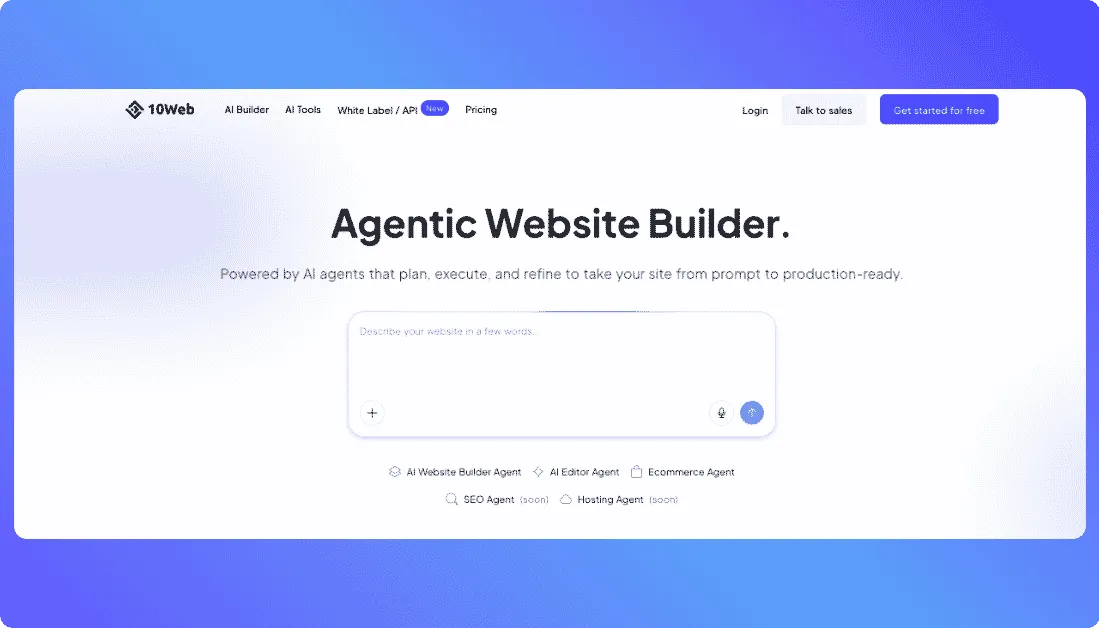
10Web combines AI website generation with the flexibility of WordPress.
You describe the business, pages, and style you want, and the platform generates a functional WordPress site instead of locking the result inside a completely separate CMS.
That is useful for B2B companies already comfortable with WordPress plugins, content workflows, and SEO.
After generation, you can continue editing the site visually or use AI to change layouts, sections, copy, and images.
10Web also supports forms, dynamic website functionality, WooCommerce, and an Elementor-based editing experience.
For a content-heavy B2B company, this setup has an obvious advantage.
Your marketing team gets AI-assisted creation without giving up the WordPress ecosystem it already knows.
You can still add plugins, publish articles, create landing pages, and extend the site as requirements change.
Key B2B Website Features
- AI-generated WordPress websites
- Elementor-based visual editing
- AI-assisted copy, images, and website sections
- Forms and dynamic website functionality
- WooCommerce support
- Responsive website generation
- WordPress plugins and customization options
Pricing
10Web currently offers discounted annual pricing for its AI website-building plans:
- AI Starter:$10/month billed annually ($120/year) — 1 website and 100 AI credits/month
- AI Premium:$15/month billed annually ($180/year) — 2 websites and 200 AI credits/month
- AI Ultimate:$22.50/month billed annually ($270/year) — 4 websites and 300 AI credits/month
- Agency Core:$80/month billed annually — supports 20 websites and 600 AI credits/month
- Agency Pro: Custom pricing for 50+ websites
The regular month-to-month prices for the core AI website plans are $20 for AI Starter, $30 for AI Premium, and $45 for AI Ultimate.
All three business plans include the AI website builder, WordPress CMS, hosting, mobile optimization, and custom-domain integration.
For a single B2B WordPress website, AI Starter begins at $10/month with annual billing, while Premium gives you more AI credits and room for a second site.
Verdict: Best for B2B companies that want an AI WordPress website builder without abandoning the flexibility and ecosystem of WordPress.
If your website will eventually connect with more complex business processes, it is also worth understanding how low-code automation can extend those workflows.
Best AI Website Builder for B2B Ecommerce and Wholesale
A lead-generation site and a wholesale store solve two very different problems.
If buyers need their own catalogs, pricing, payment terms, and ordering rules, ecommerce functionality matters more than how quickly AI can generate a homepage.
5. Shopify — Best for Manufacturers, Distributors, and Wholesale B2B

Shopify is the strongest option on this list when the website’s main job is selling products to other businesses.
Its B2B tools let companies create wholesale buying experiences alongside regular ecommerce.
You can manage company profiles, control which products different B2B buyers see, and create catalogs with specific pricing.
Shopify also supports volume pricing and quantity rules, which matters when distributors or wholesale buyers purchase in larger quantities.
That makes it a very different type of B2B website builder from Wix or Duda.
It is not just trying to capture a lead.
It can take the buyer through the purchasing process.
Shopify has also expanded core B2B functionality beyond Plus. In 2026, Basic, Grow, and Advanced merchants gained access to features such as company profiles, up to three active B2B catalogs, payment terms, and volume pricing, while more advanced catalog controls remain available on Plus.
Key B2B Commerce Features
- Company and wholesale buyer profiles
- B2B catalogs with tailored product availability
- Customer-specific pricing options
- Volume pricing and quantity rules
- Payment terms
- B2B and direct-to-consumer selling
- Buyer portal and business integrations
Pricing
Shopify currently offers a 3-day free trial followed by $1/month for the first 3 months as an introductory promotion.
Its standard plans are:
- Basic:$39/month, or $29/month billed annually
- Grow:$105/month, or $79/month billed annually
- Advanced:$399/month, or $299/month billed annually
- Shopify Plus:Starts at $2,300/month
The important change for B2B companies is that Shopify’s B2B functionality is no longer limited entirely to Shopify Plus.
Verdict: Best for manufacturers, distributors, wholesalers, and B2B brands that need serious purchasing functionality rather than a simple lead-generation website.
For a broader comparison of commerce-focused platforms
see our guide to AI ecommerce website builders.
Which AI Website Builder Fits Your B2B Workflow?
There is no single winner for every B2B company.
The right choice depends on what your website needs to do after the first AI-generated version goes live.
| Your Situation | Go With | Why |
|---|---|---|
| Need a custom website, portal, or backend workflow | Vitara.ai | Full-stack generation with editable code |
| Need a marketing and lead-generation website | Wix | Mature website, SEO, and business tools |
| Manage multiple B2B client websites | Duda | White-label and multi-site workflows |
| Want to stay with WordPress | 10Web | AI generation inside the WordPress ecosystem |
| Sell wholesale or B2B ecommerce | Shopify | Buyer accounts, catalogs, and B2B pricing |
Durable is also worth considering if your priority is getting a simple service-business website online quickly.
Framer makes more sense when design flexibility and polished landing pages matter more than complex B2B workflows.
But for custom functionality, the gap between a traditional AI website builder for B2B and a full-stack builder becomes important.
If you want to explore that newer category further, see our guide to chat-based AI app builders.
If you want to explore that newer category further
see our guide to chat-based AI app builders.
What to Check Before You Commit
Before paying for an AI website builder, test it against the website your business actually needs.
Not the demo the vendor wants you to build.
- Build Your Real B2B Funnel: Ask the platform to create your actual demo request page, qualification form, pricing flow, client portal, or landing page. A generic homepage tells you very little about whether the platform fits your sales process.
- Check Lead Routing and Integrations: An attractive form is not enough. Find out how leads reach your CRM, sales team, automation platform, or internal database. This matters even more if you need an AI website builder with CRM integration.
- Look Beyond the First AI Draft: AI can generate a site quickly. The harder question is how easily your team can add pages, change navigation, launch campaigns, publish SEO content, or restructure the website six months later.
- Understand Ownership and Lock-In: Check whether you can export code, move your data, connect APIs, use your own domain, and migrate away later. Teams building custom experiences should also review secure vibe coding practices before putting production workflows online.
- Calculate the Real Cost: Do not compare subscription prices alone. Include hosting, AI credits, plugins, ecommerce apps, team seats, integrations, and higher-tier features.
The cheapest builder at launch can become expensive once your B2B website starts doing more.
Final Takeaway
The best AI website builders for B2B companies solve very different problems.
Choose Vitara.ai if you need a custom B2B website with backend logic, portals, workflows, or application-style functionality.
Choose Wix for a conventional marketing and lead-generation site.
Choose Duda for agency and multi-site management, 10Web for WordPress, and Shopify for B2B ecommerce.
The important question is not:
“Which AI builder makes the fastest homepage?”
It is:
“Which platform can still support the business once the website becomes part of our sales and customer workflow?”
Turn your B2B website idea into a working web app with frontend, backend, GitHub-friendly code, and flexible deployment.
Try Vitara.ai Free →
Frequently Asked Questions
What is the best AI website builder for B2B companies in 2026?
Vitara.ai is a strong choice for B2B companies that need custom workflows, portals, or backend functionality. Wix is better suited to companies that mainly need a marketing website with lead-generation, content, and common business tools.
Which AI website builder is best for B2B lead generation?
Wix is one of the strongest options for traditional B2B lead generation because it combines website creation with forms, marketing, SEO, and business tools.
Vitara.ai is a better fit when the lead-generation flow requires custom logic or application-style functionality.
Can AI website builders integrate with HubSpot or Salesforce?
Yes, but the level of integration varies.
Some platforms provide native apps, while others rely on APIs, automation tools, or custom integrations.
Check exactly how form submissions, contacts, and customer data move into your existing sales stack before choosing a platform.
What is the best AI website builder for B2B ecommerce?
Shopify is the strongest choice in this list for B2B ecommerce because it supports wholesale-focused features such as company accounts, catalogs, quantity rules, volume pricing, and payment terms.
Are AI-built websites good for SEO?
They can be.
The AI-generated draft matters less than whether you can control page titles, metadata, URLs, internal links, content structure, performance, and ongoing publishing.
Human editing is still important for search intent, accuracy, and useful B2B content.
What is the difference between an AI website builder and an AI app builder?
An AI website builder usually focuses on pages, design, content, forms, and publishing.
An AI app builder can go further by generating frontend interfaces, backend logic, APIs, authentication, databases, and custom workflows.
That distinction matters when a B2B website needs to function more like software than a digital brochure.
What’s New?