7 Best Rocket.new Alternatives in 2026
Let’s be honest, using Rocket.new for the first time feels pretty exciting. You describe what you want, click a few buttons, and suddenly you’ve got an app taking shape way faster than you expected.
I get why people like it. I’ve used Rocket.new myself, tested its features, explored the build quality, and for quick momentum, it does a lot right.

But once the initial wow factor fades, the trade-offs start showing up. Over the last 1.5 years, I’ve tested many AI app builders, and here are the best Rocket.new alternatives I’d actually recommend.
Quick Comparison of Top 7 Rocket.new Alternatives
| Tool | Best For | What stands out | Where it can feel limited | Best choice if you want… |
|---|---|---|---|---|
| Vitara.ai | Full stack app building with faster setup | Builds web and mobile apps from natural language and supports code download on paid plans | Not as widely known as some bigger AI builders yet | A Rocket.new alternative that still feels full stack and practical for shipping real products |
| Lovable | Fast MVPs, internal tools, and polished UI first builds | Very approachable and strong for quickly turning ideas into working apps and websites | Can feel more frontend first when you need deeper backend flexibility | A cleaner and beginner friendly option for moving from idea to prototype fast |
| Vercel v0 | Developers, product teams, and frontend heavy workflows | Strong at generating web apps and collaborating around real code with Vercel workflows | Best fit for web first teams already in the Vercel ecosystem | More developer control and stronger web app workflows with easier iteration |
| Bolt.new | Rapid prototyping and browser based full stack building | Prompt, run, edit, and deploy apps directly in the browser with no local setup | Can get messy on larger builds when long term maintainability is needed | Speed, flexibility, and a very hands on vibe coding experience |
| Glide | Internal tools, operations apps, and business software | No code app builder that works well for business workflows and data driven apps | Less ideal for full custom product behavior or developer style stacks | An easier path for building portals and internal business apps |
| Emergent | Production ready apps and team use cases | AI agents that design, code, and deploy full applications with enterprise readiness signals | Feels more enterprise focused than what solo builders may need | A strong option for teams focused on production readiness and workflow depth |
| Base44 | Non technical users who want complete apps fast | Includes built in infrastructure like database, authentication, permissions, and hosting | Less flexible for developers who want deep control from the start | A simple way to launch business apps, portals, and back office tools quickly |
Why Are Current Users Looking for Rocket.new Alternatives?
Token burn adds up fast
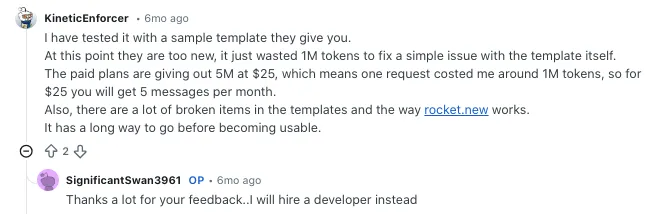
One of the clearest complaints is cost efficiency. In a Reddit thread, KineticEnforcer said Rocket.new “wasted 1M tokens to fix a simple issue,” which is a big red flag for anyone building through trial and error. Another user, JadedJuggernaut1538, said the platform kept using tokens fixing the same simple error again and again. That kind of loop is exactly why some users start looking for cheaper, more predictable Rocket.new alternatives.
Source of Information: Reddit
It feels great for prototypes, but confidence drops on bigger builds
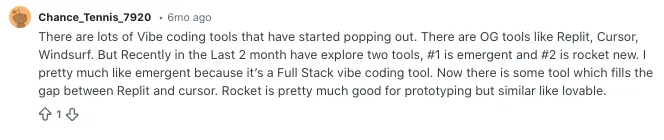
Rocket.new gets praise for fast MVP creation, design-to-build speed, and quick app generation. But even users discussing it positively tend to frame it as a strong prototyping tool first, not always the safest pick for more complex or long-term builds. In one Reddit discussion, Chance_Tennis_7920 described Rocket.new as “pretty much good for prototyping,” which says a lot about how the market currently sees it.
Source of Information: Reddit
Free and lower-tier limits can feel restrictive
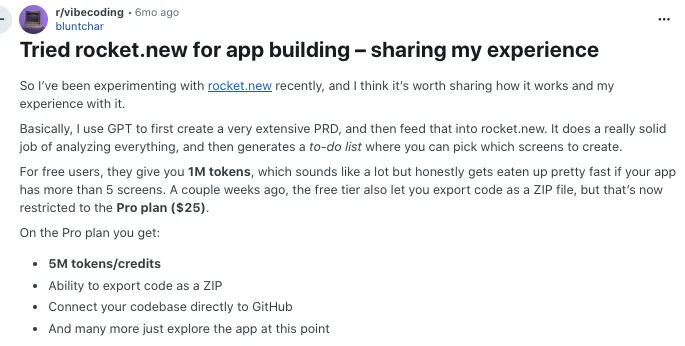
Another reason people compare Rocket.new with alternatives is pricing pressure tied to credits. A Reddit post about using Rocket.new points out that the free tier’s 1M tokens can disappear quickly once your app grows past a few screens, while code export is restricted to the paid plan. For users who want to iterate a lot, that model can start feeling tight pretty quickly.
Source of Information: Reddit
Users still question how production-ready it really is
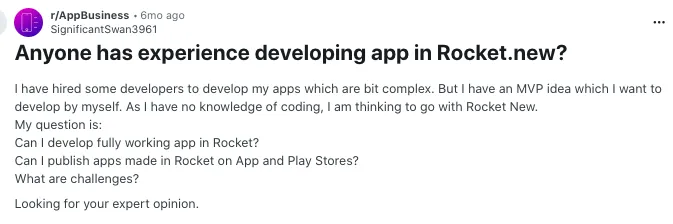
When people ask about Rocket.new in communities, the recurring theme is not “Can it make something?” but “Can it handle a fully working app?” In the AppBusiness thread, the whole discussion centers around whether it can support real app-store-ready projects and what the challenges are for non-coders. That kind of hesitation usually means users see promise, but not enough certainty yet for serious production work.
Source of Information: Reddit
The tool is still seen as early by some testers
A few comments are more blunt. In one Reddit discussion, KineticEnforcer said Rocket.new has “a long way to go before becoming usable,” pointing to broken template items and token waste during fixes. That kind of first-hand feedback matters because it shows why some early adopters move toward tools like Lovable, Bolt.new, Glide, or Emergent after testing Rocket.new for real projects.
Source of Information: Reddit
Source threads and discussions: Reddit discussions from KineticEnforcer, JadedJuggernaut1538, and other Rocket.new users are the clearest public signals behind this shift toward alternatives.
Top Rocket.new Alternatives in 2026
If Rocket.new feels a little too limiting once your app gets more serious, these alternatives give you more room to build, tweak, and actually grow.
1. Vitara.ai
2. Lovable
3. Vercel v0
4. Bolt.new
5. Glide
6. Emergent
7. Base44
1. Vitara.ai

Vitara.ai feels like a more complete Rocket.new alternative if you want to build beyond a quick demo. It helps you create full-stack web and mobile apps from simple prompts, and it handles both the frontend and backend in one place. That makes it a strong fit for founders and teams who want speed without giving up too much structure.
What I like here is that Vitara.ai is clearly trying to be more than a prompt-to-UI tool. It includes React for the frontend, Supabase for the backend, GitHub integration, browser-based development, and editable code you can export later. So if you like the speed of Rocket.new but want more control over what happens after the first build, this starts to look like a better long-term option.
Features
- Build full-stack web and mobile apps from natural language prompts.
- React frontend with a Supabase backend built into the workflow.
- Browser-based development with no local setup required.
- GitHub integration for version control and collaboration.
- Editable code with export support.
- Custom domain support on paid plans.
Pros
- Better fit than Rocket.new for users who want full-stack app building, not just fast generation.
- Gives you real code ownership and manual editing flexibility.
- Works for both web apps and mobile apps.
- Clean pricing structure that is easier to understand than many credit-heavy tools.
- Good option for non-technical founders who still want room to scale later. This is my inference based on its prompt-based workflow plus code export and full-stack setup.
Cons
- Still newer and less established than some bigger names in the AI app builder space. This is an inference from the available public footprint, not a claim made by the company.
- Free usage is limited to 5 daily credits and 20 total one-time credits.
- Heavier users will likely need a paid plan pretty quickly.
Best For: Founders, solo builders, startups, and teams that want a Rocket.new alternative with more full-stack flexibility, code control, and room to grow.
Pricing:
- Starter – Free: 5 credits per day, 20 total one-time credits, prompt-based building.
- Build – $20/month: 100 monthly credits, code editing and download, custom domain support, faster AI processing.
- Scale – $50/month: Everything in Build plus 250 monthly credits.
- Custom plan: Contact sales for tailored needs.
2. Lovable
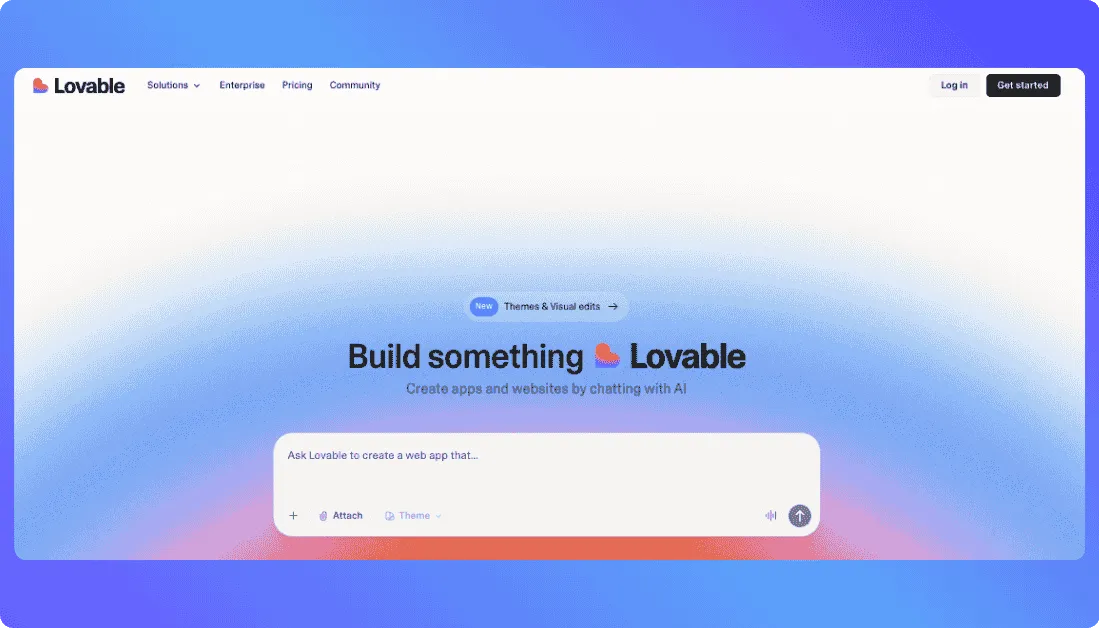
Lovable is one of the strongest Rocket.new alternatives if you want to turn an idea into a working app without getting buried in setup. It helps you build apps, websites, and internal tools through chat, and it is especially popular with founders and non-technical builders who want to move fast.
What makes Lovable stand out is that it goes beyond simple UI generation. It supports full app building, offers custom domains on paid plans, includes user roles and permissions, and adds team features as you move up the pricing ladder.
So if you like Rocket.new’s speed but want something that feels a little more polished for real workflows, Lovable is an easy tool to consider.
Features
- Build apps, websites, and digital products through chat.
- Full-stack app generation with backend, auth, and deployment in its broader workflow positioning.
- 100 monthly credits on Pro, plus 5 daily credits up to 150/month.
- Custom domains and unlimited lovable.app domains on Pro.
- User roles, permissions, team workspace, and SSO on higher tiers.
- Credit rollovers and on-demand credit top-ups.
Pros
- Very beginner-friendly if you want to build fast without much setup.
- Better fit than Rocket.new for people who want a smoother idea-to-app workflow. This is my inference based on its positioning and team features.
- Flat pricing shared across unlimited users on Pro and Business is appealing for small teams.
- Good mix of speed, polish, and collaboration features.
- Strong option for founders, internal tools, and MVPs. This is an inference supported by Lovable’s own use-case positioning.
Cons
- Credit-based usage can still add pressure if you iterate heavily.
- More advanced business controls sit behind higher plans.
- Teams that want deeper developer-first workflows may still prefer tools like v0 or Cursor. This is an inference based on product positioning.
Best For: Founders, startups, product teams, and non-technical builders who want a Rocket.new alternative that feels fast, polished, and easier to work with day to day.
Pricing:
- Free – $0/month: Entry-level access for exploring the product.
- Pro – $25/month: 100 monthly credits, 5 daily credits, custom domains, rollovers, and top-ups.
- Business – $50/month: Adds SSO, team workspace, design templates, and security controls.
- Enterprise – Custom: For larger teams that need governance, onboarding, and dedicated support.
Also Read: Top Lovable Alternatives
3. Vercel v0
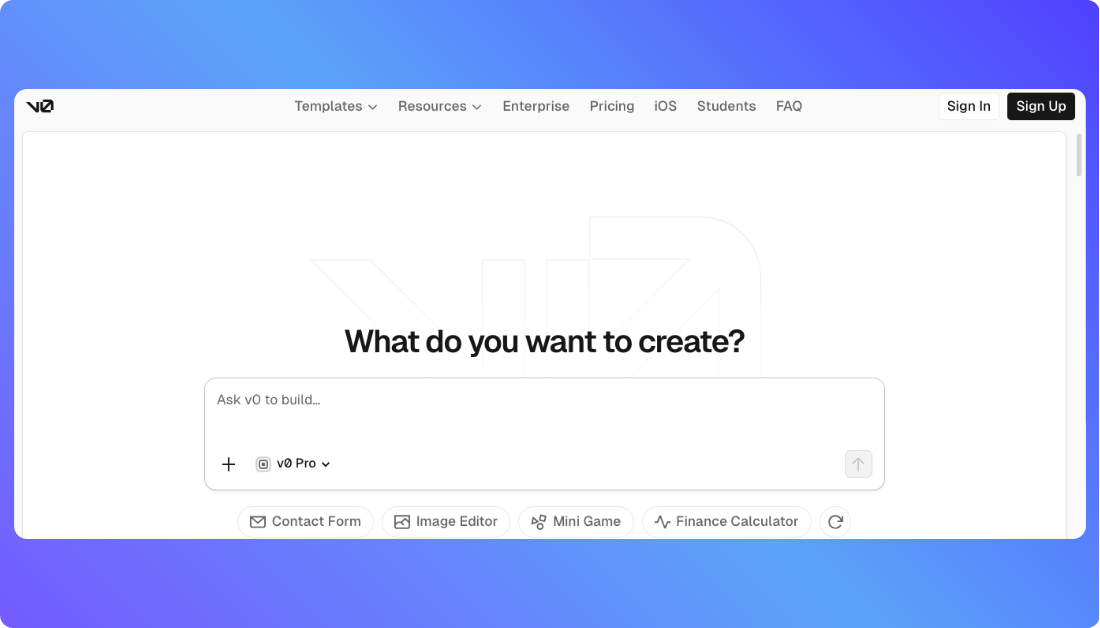
Vercel v0 is a great Rocket.new alternative for builders who care more about production-style web apps than quick all-in-one app generation. It helps you create real code and full-stack web apps with natural language, and it is tightly connected to the Vercel ecosystem.
What I like about v0 is that it feels more developer-friendly from the start. You are not just getting a visual output. You are getting real web app code, collaboration features on team plans, shared projects, deployments, and a path that makes more sense if engineers will keep building on top of what AI generates. That makes it a smart choice if Rocket.new feels a little too closed or too lightweight for serious web product work.
Features
- Create real code and full-stack web apps with prompts.
- Deploy to production immediately or open a pull request for review.
- Shared projects, collaboration, and team features on higher plans.
- Access controls and data opt-out on higher tiers.
- API access on Business and above.
Pros
- Stronger fit than Rocket.new for web-focused teams that want real code handoff.
- Pricing starts lower than several other premium AI builders.
- Good choice for product teams already working with Vercel. This is an inference based on ecosystem fit.
- Collaboration is better structured than many solo-first AI app builders.
- Better long-term option if engineers need to extend the project after generation. This is an inference based on real-code output and deployment workflow.
Cons
- Best fit is web apps, not broader mobile-first use cases. This is an inference from product positioning.
- Less beginner-oriented than tools built mainly for non-technical founders. This is an inference based on its code-first and Vercel-centered workflow.
Best For: Developers, product teams, startups, and web-first companies that want a Rocket.new alternative with stronger code quality, collaboration, and deployment workflows.
Pricing:
- Free – $0/month: For exploring v0 with basic limits.
- Premium – $20/month: Higher limits for individual power users.
- Team – $30/user/month: Shared projects, shared credit pool, and team collaboration.
- Business – $100/user/month: Adds privacy controls, data opt-out, and more advanced team use.
- Enterprise – Custom: For large organizations with security and governance needs.
Also Read: Best VercelV0 Alternatives
4. Bolt.new
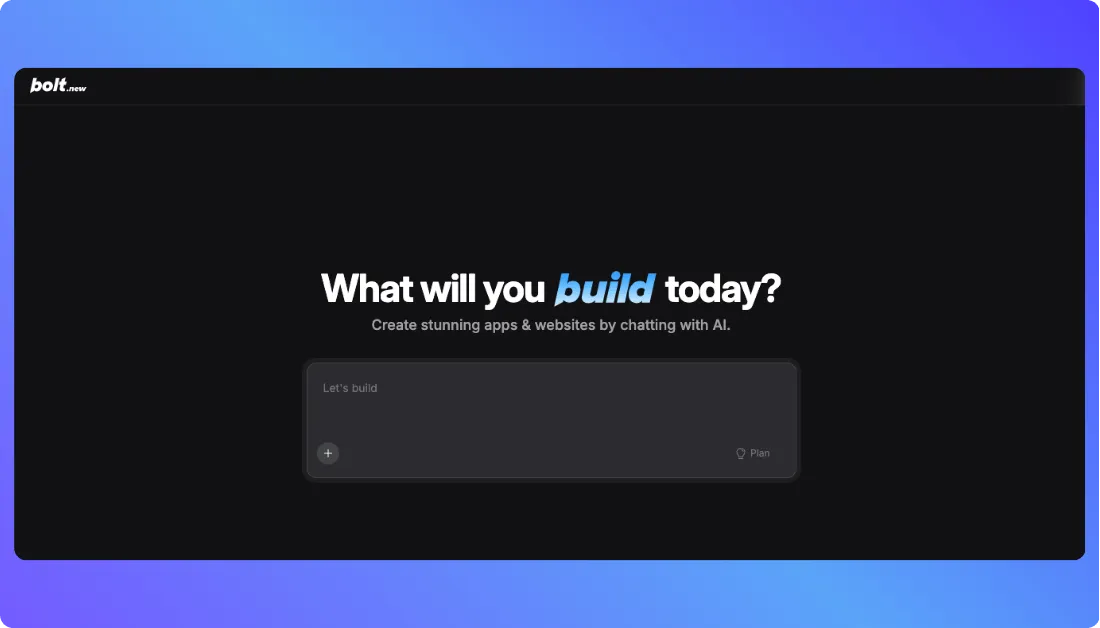
Bolt.new is one of the most talked-about Rocket.new alternatives because it makes browser-based app building feel fast and immediate. You can start from a prompt, import from Figma or GitHub, and build apps and websites without setting up a local development environment.
The big reason people choose Bolt is speed. It is built for quick building, rapid iteration, and getting a working prototype in front of people fast.
Features
- Build apps and websites by chatting with AI in the browser.
- Import from Figma or GitHub.
- Website hosting, unlimited databases, and custom domains on paid plans.
- Team-level access management and centralized billing on Teams.
- SEO boosting and AI image editing on Pro.
- Free and Pro hosting options through Bolt Cloud.
Pros
- Very fast for rapid prototyping and idea testing.
- No local setup makes it easy for beginners to jump in.
- Useful for both solo builders and teams.
- Paid plans remove branding and add private sharing, which helps for client or startup work.
Cons
- Token usage can rise fast on larger projects because project syncing drives cost.
- Teams pricing scales per member, so costs can climb faster than flat-rate tools.
Best For: Founders, designers, marketers, solo builders, and fast-moving teams that want a Rocket.new alternative built for quick prototyping, browser-based development, and easy sharing.
Pricing:
- Free – $0/month: Public and private projects, 300K daily token limit, 1M tokens/month, hosting, and unlimited databases.
- Pro – $25/month: 10M tokens/month, no daily token limit, custom domains, SEO boosting, and AI image editing.
- Teams – $30/member/month: Adds centralized billing, team access controls, and organization sharing.
- Enterprise – Custom: Advanced security, SLAs, onboarding, and priority support.
Also Read: Top Bolt.New Alternatives
5. Glide
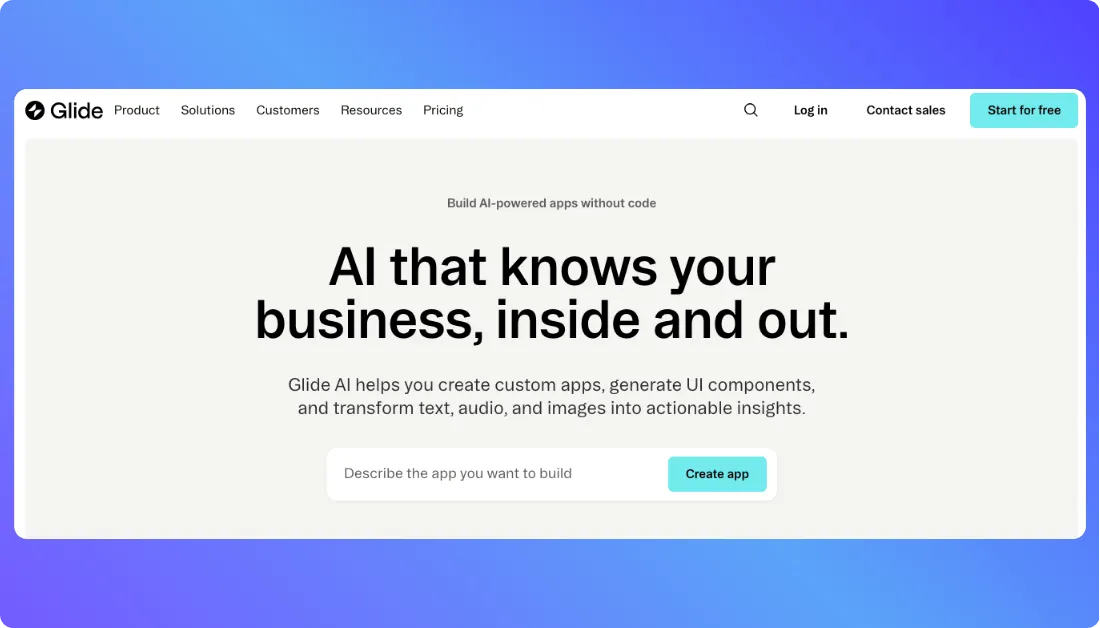
Glide is a very different kind of Rocket.new alternative, but that is exactly why it makes sense for a lot of users. Instead of focusing on pure prompt-to-app generation, Glide is built around turning spreadsheets and business data into polished internal tools, portals, dashboards, and AI-powered apps without code.
What makes Glide stand out is how practical it feels for real business use. You can connect data from Glide Tables, Google Sheets, Airtable, Excel, and even SQL sources on higher tiers, then add workflows, APIs, and AI features on top. So if Rocket.new feels more like a fast app generator, Glide feels more like a serious business app platform for teams that care about operations and day-to-day usefulness.
Features
- Turn spreadsheets and business data into AI-powered apps without coding.
- Connect data from Glide Tables, Google Sheets, Airtable, Excel, and supported SQL sources.
- Workflows, API support, and Glide AI on paid plans.
- 40+ components for building dashboards, portals, and business tools.
- Mobile-adaptive apps that work across desktop, tablet, and phone.
- Templates for portals, dashboards, CRM, project management, and more.
Pros
- Better than Rocket.new for internal tools, portals, and workflow-heavy business apps. This is my take based on Glide’s product focus and data-first setup.
- Strong data-source support makes it practical for real operations work.
- AI features are built into workflows, not just app generation.
- Good fit for teams that want less coding and more operational speed.
- Scales from simple apps to enterprise use cases.
Cons
- Much more business-focused than startup-MVP-focused. This is an inference from Glide’s pricing and positioning.
- Pricing jumps quickly once you move beyond free use.
- Less suitable if you want a developer-style full-stack code workflow. This is my take based on how Glide is structured.
Best For: Operations teams, SMBs, and companies that want a Rocket.new alternative for dashboards, portals, internal tools, and workflow automation rather than pure vibe-coded product builds.
Pricing:
- Free – $0/month: Unlimited drafts, 1 editor, up to 25k rows.
- Business – Starting at $199/month billed yearly: Unlimited apps, 30 users included, 5,000 updates, and business features like Workflows, Call API, and Glide API.
- Enterprise – Custom: SSO, backups, enterprise integrations, account manager, and priority support.
Also Read: Best Glide Alternatives
6. Emergent
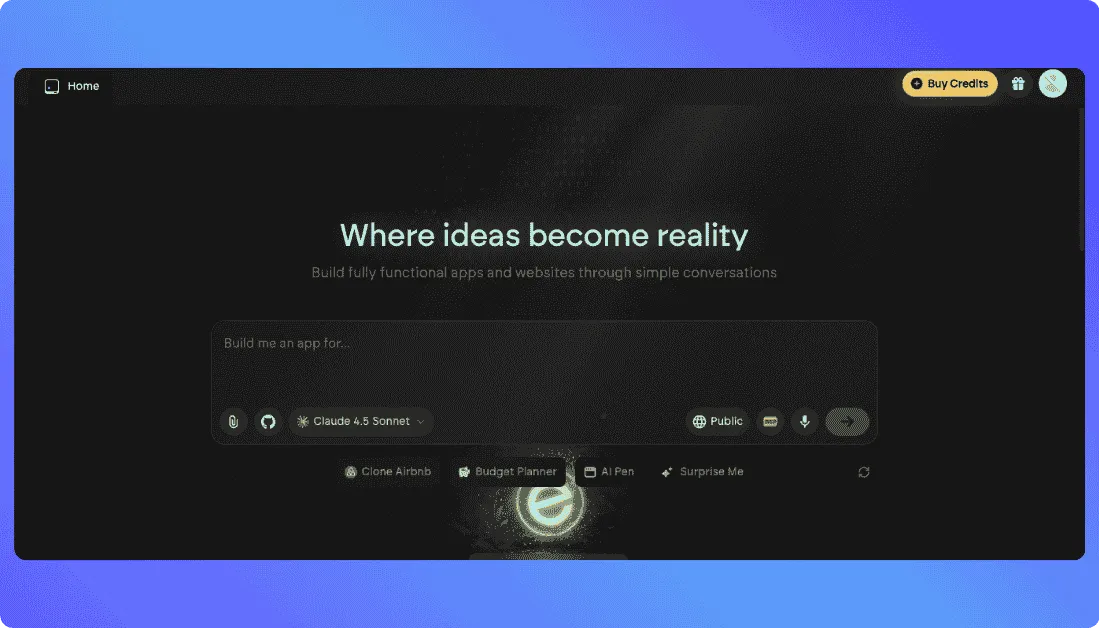
Emergent is one of the more serious Rocket.new alternatives if your main goal is to build production-ready apps through AI, not just generate a quick concept. The platform says it uses AI agents to design, code, and deploy your application from start to finish, and it supports both web and mobile experiences.
What makes Emergent interesting is how strongly it leans into full-app execution. Even its lower paid tier includes private project hosting, GitHub integration, and web and mobile app building. Then its higher tier adds a 1M context window, custom AI agents, system prompt editing, and priority support. So compared with Rocket.new, Emergent feels more aimed at people who want a heavier-duty AI app builder with more technical depth.
Features
- AI agents that design, code, and deploy apps from conversation.
- Build web and mobile apps on paid plans.
- Private project hosting on Standard.
- GitHub integration and task forking on Standard.
- Custom AI agents, system prompt editing, and 1M context window on Pro.
- SOC 2 Type II positioning for trust and enterprise readiness.
Pros
- Stronger production-ready positioning than many vibe coding tools.
- Better fit than Rocket.new for teams that want GitHub integration and private hosting from the start.
- Supports both web and mobile app creation.
- Higher-end AI controls are useful for advanced builders.
- Security posture is a plus for companies and agencies.
Cons
- Pro pricing is much higher than most creator-focused app builders.
- The messaging is more serious and enterprise-leaning, which may feel like too much for beginners. This is my take based on the way Emergent positions the product.
- Extra credits may still be needed as usage grows.
Best For: Startups, agencies, product teams, and businesses that want a Rocket.new alternative focused on production-ready full-stack builds, stronger workflows, and more serious deployment capabilities.
Pricing:
- Free – $0/month: 10 free monthly credits and access to core platform features.
- Standard – $20/month annually: 100 credits per month, private hosting, GitHub integration, and web/mobile app building.
- Pro – $200/month annually: 750 monthly credits, 1M context window, custom AI agents, and priority support.
- Enterprise – Custom: For larger teams and enterprise needs.
Also Read: Best Emergent Alternative
7. Base44
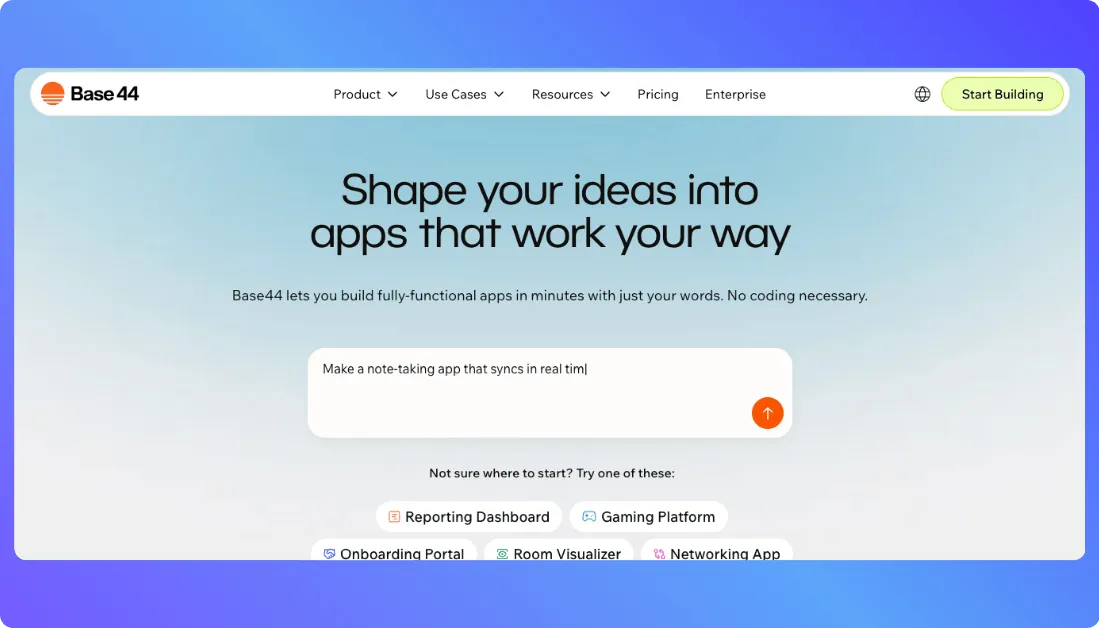
Base44 is one of the most beginner-friendly Rocket.new alternatives if you want to build a fully working app with plain language and avoid piecing together your own stack. It positions itself as an AI-powered app builder that can turn ideas into functioning apps in minutes, with no coding required.
Features
- Build fully functional apps in minutes with natural language.
- Automatic backend setup with authentication, data storage, and role-based permissions.
- Built-in hosting, analytics, and custom domains.
- Integrated backend and database system across plans.
- Multi-user editing, collaboration, payment processing, email tools, and debugging tools.
- In-app code edits, backend functions, and GitHub integration on higher plans.
Pros
- Very approachable for non-technical builders.
- Better than Rocket.new if you want more built-in backend structure out of the box. This is my take based on Base44’s product design.
- Good mix of app generation, hosting, analytics, and integrations in one place.
- App ownership stays with the user.
Cons
- Free usage is pretty limited. The pricing page shows 25 message credits per month, while the FAQ also mentions a daily allowance of 5 messages and a monthly cap of 25, so the exact free-plan framing is a little inconsistent across the page.
- More advanced capabilities sit behind paid plans.
- Heavy-use teams may outgrow the lower tiers quickly because message and integration credits scale by plan.
Best For: Solo founders, non-technical users, and small teams that want a Rocket.new alternative with built-in backend, hosting, and a smoother all-in-one path from idea to live app.
Pricing:
- Free – $0/month: 25 message credits per month and core Base44 features.
- Starter – $20/month: 100 message credits and 2,000 integration credits per month.
- Builder – $40/month: 250 message credits, 10,000 integration credits, in-app code edits, backend functions, and domain connection.
- Pro – $80/month: 500 message credits, 20,000 integration credits, AI model select, GitHub integration, and early beta access.
- Elite – $160/month: 1,200 message credits, 50,000 integration credits, and premium support.
Also Read:

Final Thoughts
Rocket.new is a solid starting point if you want to turn an idea into an app fast, especially when speed matters more than deep control. But once your project starts growing, a lot of users realize they need better flexibility, cleaner workflows, or a platform that feels more reliable for serious builds.
That’s where these Rocket.new alternatives stand out. Some are better for fast MVPs, some are stronger for internal tools, and others make more sense if you want full-stack control and room to scale. The right choice really comes down to what you’re building, how hands-on you want to be, and how far you plan to take it.
Frequently Asked Questions
What is the best Rocket.new alternative in 2026?
There isn’t one single best option for everyone because it depends on what you’re trying to build. If you want speed, tools like Lovable and Bolt.new make a lot of sense, while Vitara.ai and Emergent are better if you want more full-stack depth.
For business apps and internal tools, Glide and Base44 can be a better fit than Rocket.new. Vercel v0 stands out more for developers and web-focused teams that want cleaner code workflows.
Which Rocket.new alternative is best for beginners?
If you’re just getting started, these are usually the easiest options to look at:
- Lovable for simple and polished app building
- Base44 for all-in-one app creation with built-in backend features
- Glide for internal tools and data-based business apps
- Bolt.new if you want a fast browser-based builder with no setup
Are there cheaper Rocket.new alternatives?
Yes, and that’s one reason many users start comparing tools in the first place. Some alternatives give you a more flexible free plan, while others make paid plans feel more predictable once you start building larger projects.
Bolt.new, Vitara.ai, and Vercel v0 all have entry-level plans that can work well depending on your usage. The better question is not just which one is cheaper, but which one gives you better value for the kind of app you want to build.
Which Rocket.new alternative is best for full-stack app building?
For full-stack app building, Vitara.ai and Emergent are two of the strongest options from this list. They are better suited for users who want frontend and backend support in one workflow instead of stopping at a quick prototype.
If you want a tool that feels more complete once your project grows, those two are usually more practical than a lightweight prompt-to-app builder.
Can I switch from Rocket.new to another tool later?
Yes, but how easy that switch feels depends on the platform you move to and how much control you have over your code. Some tools make migration easier by offering code export, GitHub integration, or more open development workflows.
That’s why many builders think about this early. If long-term flexibility matters to you, it’s smart to choose a Rocket.new alternative that gives you more ownership from the start.
What’s New?